


A manuscript containing astronomical observations from the "Spring and Autumn Annals" and the "Hsuan thu"-diagram
"Eclipses du Tchun Tsieou". Autograph manuscript.
Large folio. French manuscript on rice paper. (40) pp. (alternate pages blank, bound in reverse order). With a diagram leaf bound in before the first page. Modern quarter morocco, title in gilt on spine.
€ 35.000,00
Manuscript of seven tables and a diagram-leaf concerning Chinese records of solar eclipses, lunar eclipses, the Twenty-Eight Mansions of the Chinese constellations system, the sexagenary cycle of the Chinese calendar, and geometry with Gaubil's extensive commentary. The first three tables cataloguing solar and lunar eclipses were published in 1732 by Étienne Souciet as part of Gaubil's "Traité de l'Astronomie Chinoise" (corresponding to pp. 239-373). Gaubil probably finished this manuscript in 1731 and sent it to his publisher Souciet in Paris, who left some editor's marks in ink and noted on the first page that the here-missing preface is to be found in a different booklet ("La Preface est Cahier 2d, p. 10"). The four tables on Chinese constellations and the Chinese calendar, as well as the diagram leaf, also relate to the "Traité" but were published within the "Histoire de l'Astronomie Chinoise avec des Dissertations", the second volume of Souciet's publications of Gaubil's work. It is worth mentioning that while no Chinese types were used for any of Souciet's publications, Gaubil's catalogues of eclipses includes Chinese characters for some of the astronomical terms and names of dynasties. In the tables concerning Chinese constellations and the Chinese calendar, Gaubil systematically uses the original Chinese characters alongside their romanizations.
In the published preface to the tables, Gaubil criticizes the inaccuracy of a catalogue of eclipses in Philippe Couplet's 1686 "Tabula Chronologica Monarchiae Sinicae" that supposedly gave Giovanni Domenico Cassini "false ideas about the Chinese calendar". Although he deems excellent Johann Adam Schall von Bell's "Gu jin jiao shi kao" ("Survey of eclipses of the present and past"), a catalogue of eclipses until 1627, he decided that it was time for a new catalogue. Gaubil lays down his sources, starting with the "Chunqiu" or "Spring and Autumn Annals", here romanized as "Tchun Tsieou", a core Chinese classic and the oldest surviving Chinese annals covering a 241-year period from 722 to 481 BCE. For the following centuries, Gaubil relied on different dynastic chronologies, Schall's treatise, and Ignaz Kögler's records from the Imperial tribunal of mathematics and astronomy, although the latter prove disappointing. The painstakingly comprehensive work exhibited in these tables was invaluable not only for astronomers and those interested in the history of Chinese astronomy, but also for the European knowledge of Chinese history at large, as they harmonize Chinese and European chronology. This task was performed by Gaubil and fellow Jesuits before and after him, and Gaubil is also a chronicler of this coalescence of European and Chinese astronomy and history in general with his tables and beyond. The earliest Jesuit observation of a lunar eclipse, documented in the third table, came to Gaubil's attention via a Chinese source. According to this source, a lunar eclipse was observed by a missionary in Jiangsu in 1627 (Julian date) that was also observed by Jesuits in Beijing. The same astronomical event was observed in Europe by Jacques Grandami, Denis Pétau, Pierre Gassendi, Johannes Kepler, and Giovanni Battista Riccioli on 20 January 1628, which allows Gaubil to correct the observations made by his predecessors in China with respect to the duration of the eclipse. In a note, Gaubil points to his source, unfortunately omitting the title: "The Chinese book from which I drew this observation does not mention the missionary's name". A likely candidate is Johann Adam Schall von Bell himself, as he was active as a missionary in Jiangsu between 1627 and 1630. Gaubil also mentions observations of the moons of Jupiter made in Jiangsu since. These observations were probably made at the old Imperial observatory in Nanjing before its main instruments were transferred to Beijing in 1668.
The highly interesting diagram leaf with four geometrical figures bound before the first page corresponds to a chapter in Gaubil's "Traité de l'Astronomie Chinoise", wherein he introduces the ancient astronomical and mathematical treatise "Zhoubi Suanjing", here romanized as "Tcheou Pey". The most remarkable figure is a representation of the famous "Hsuan thu" or "Gougu Theorem" diagram, one of the earliest known proofs of the Pythagorean theorem.
In the tables on the Chinese calendar, Gaubil harmonizes the Chinese sexagenary cycle, the twelve-year-cycle of the Chinese zodiac, and the twelve Terrestrial Branches with corresponding periods in the Julian calendar (1684-1731, 772-783, and 1720-31 CE).
Antoine Gaubil, who arrived in Beijing in 1722 and would remain there for the rest of his life, was the most important astronomer among the French Jesuits in China, and one of the greatest disseminators of Chinese science and wisdom in Europe in the 18th century. His work on astronomy and as a historian and translator of important Chinese texts such as the "I Ching" earned him the praise of Alexander von Humboldt as the wisest of the Jesuit missionaries. Joseph Needham even considers him "the interpreter general and father superior of Chinese astronomy".
Formerly in the library of Sir Thomas Phillipps (1792-1872). Dispersed over several decades in the 20th century, his manuscript collection is considered the largest ever privately assembled to this day.
Occasional insignificant spotting. Three pages partly cut along the pencil lines and one page with minor damage due to ink corrosion.
Published in: Observations mathématiques, astronomiques, géographiques, chronologiques et physiques, tome 3. Contenant un Traité de l'Astronomie Chinoise (Rollin: Paris, 1732), pp. 239-373, and Observations mathématiques, astronomiques, géographiques, chronologiques et physiques, tome 2. Contenant une "Histoire de l'Astronomie Chinoise avec des Dissertations (Rollin: Paris, 1732), pp. 174-184 & plates 1-3.
Ähnlich
-
Eigenh. Briefkarte mit U.Prag, 16.01.1889.
€ 85,00 -

"Pour le Catalogue des Éclipses de Soleil et de Lune". Autograph manuscript.Beijing, 1734-1735.
€ 30.000,00 -

"Traité de l'Astronomie Chinoise". Autograph manuscript.Beijing, 1730-1731.
€ 65.000,00 -
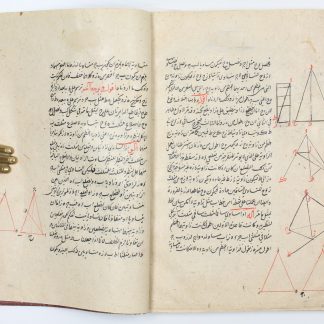
A manuscript collection of three treatises on astronomy and mathematics.Safavid Persia; copied in al-Jauhariyya School, Isfahan, each treatise dated 1619/20 CE = 1029 H.
€ 35.000,00
