

Previously undiscovered: a new attribution to al-Buni, on the art of magic talismans
Al-Tarajuh fi Fann al-Tanazuh.
8vo (138 x 180 mm). 42 ff. Arabic manuscript on paper. Black naskh script with titles and diagrams picked out in red. Opens with full-page gold frame and medallion, details picked out in black and blue ink, and with red ink talismanic diagrams throughout. 18th century full leather with flap, stamped in gilt and blind, rebacked.
€ 75.000,00
A previously unknown work attributed to one of the most famous authors of Arabic charms, talismans, and folk magic: Ahmad Al Buni (d. 1225 CE), whose name appears twice in the manuscript, both in the title-page and the first page of text. This manuscript, dating to the 13th or 14th century CE, is an early and fascinating survival, likely written down shortly after Al Buni's lifetime, detailing a treasure trove of medieval Arabic talismanic traditions. Al Buni himself is best known for the work "Shams al Ma'arif", the most famous and perhaps most frequently banned work in Arabic on magical practices.
This manuscript focuses entirely on talismans: their different uses and their various structures, especially organized as tables (Al Buni is also particularly well known for popularizing magic squares).The author explains the different uses of each type of talisman, the use of tables, and the values assigned to letters and numbers. Instructions for full talismans include those designed to help find a lost or stolen item, for having children, or for freeing someone from prison. Others ease birth, create love, or compel a partner to obey your will; these are to be written in the blood of a crow, owl, or dragon.Others must be inscribed on daggers or deerskin, and have the power to bring people together or split them apart.
As this work is, to the best of our knowledge, entirely unique, it is difficult to judge exactly how many leaves are missing from a few small gaps in the text; however, these appear to be minor, and likely only comprise a few leaves.Not only is this work an entirely new attribution to Al Buni, but it does not match any known work on talismans and is a quite early text, dated by its paper and palaeographic style to the century of or that following Al Buni's own lifetime. With its illustrative diagrams, it is a wonderful survival.
Binding rebacked, endpapers replaced, very subtle paper repairs; with a few leaves missing as stated. Otherwise very well preserved.
Ähnlich
-

A midshipman journal, including "General Account of the Persian Gulf Cable …Various places, on the SS International, 1878-1888.
€ 19.500,00 -
Le dernier héritage des califes.Beirut, ca. 1940.
€ 4.500,00 -
![Voyage [...], fait en M.DCCXIV, &c. par ordre de Louis XIV. dans la Turquie, l'Asie, Sourie, Paléstine, Haute et Basse Égypte, &c.](https://inlibris.com/wp-content/uploads/2020/04/img-bn33482-324x324.jpg)
Voyage [...], fait en M.DCCXIV, &c. par ordre de Louis XIV. dans la …Amsterdam, 1720.
€ 2.500,00 -
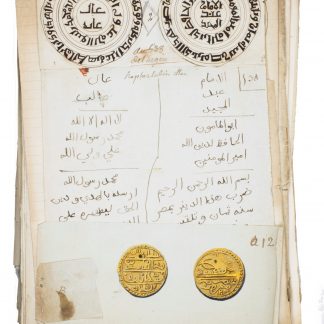
Islamic coins and medals.Paris?, ca. 1791-1817?.
€ 28.000,00
