
![Kalpasutra [and] Kalikacharyakath [The Book of the Ritual and the Legend of Prince Kalaka].](https://inlibris.com/wp-content/uploads/2025/04/img-bn66658.jpg)
![Kalpasutra [and] Kalikacharyakath [The Book of the Ritual and the Legend of Prince Kalaka]. – Bild 2](https://inlibris.com/wp-content/uploads/2025/04/img-bn66658-a.jpg)
![Kalpasutra [and] Kalikacharyakath [The Book of the Ritual and the Legend of Prince Kalaka]. – Bild 3](https://inlibris.com/wp-content/uploads/2025/04/img-bn66658-b.jpg)
![Kalpasutra [and] Kalikacharyakath [The Book of the Ritual and the Legend of Prince Kalaka]. – Bild 4](https://inlibris.com/wp-content/uploads/2025/04/img-bn66658-c.jpg)
![Kalpasutra [and] Kalikacharyakath [The Book of the Ritual and the Legend of Prince Kalaka]. – Bild 5](https://inlibris.com/wp-content/uploads/2025/04/img-bn66658-d.jpg)
![Kalpasutra [and] Kalikacharyakath [The Book of the Ritual and the Legend of Prince Kalaka]. – Bild 6](https://inlibris.com/wp-content/uploads/2025/04/img-bn66658-f.jpg)
![Kalpasutra [and] Kalikacharyakath [The Book of the Ritual and the Legend of Prince Kalaka]. – Bild 7](https://inlibris.com/wp-content/uploads/2025/04/img-bn66658-g.jpg)
![Kalpasutra [and] Kalikacharyakath [The Book of the Ritual and the Legend of Prince Kalaka]. – Bild 8](https://inlibris.com/wp-content/uploads/2025/04/img-bn66658-h.jpg)
![Kalpasutra [and] Kalikacharyakath [The Book of the Ritual and the Legend of Prince Kalaka]. – Bild 9](https://inlibris.com/wp-content/uploads/2025/04/img-bn66658-i.jpg)
![Kalpasutra [and] Kalikacharyakath [The Book of the Ritual and the Legend of Prince Kalaka]. – Bild 10](https://inlibris.com/wp-content/uploads/2025/04/img-bn66658-j.jpg)
![Kalpasutra [and] Kalikacharyakath [The Book of the Ritual and the Legend of Prince Kalaka]. – Bild 11](https://inlibris.com/wp-content/uploads/2025/04/img-bn66658-k.jpg)
![Kalpasutra [and] Kalikacharyakath [The Book of the Ritual and the Legend of Prince Kalaka]. – Bild 12](https://inlibris.com/wp-content/uploads/2025/04/img-bn66658-l.jpg)
![Kalpasutra [and] Kalikacharyakath [The Book of the Ritual and the Legend of Prince Kalaka]. – Bild 13](https://inlibris.com/wp-content/uploads/2025/04/img-bn66658-e.jpg)
15th century Jain manuscript illustrated in gold
Kalpasutra [and] Kalikacharyakath [The Book of the Ritual and the Legend of Prince Kalaka].
Tall 4to (285 x 148 mm). 78 ff. Prakrit and Sanskrit manuscript on paper. Black Jain Nagari script ruled in red. Illustrated with 23 hand-painted miniatures, with figures painted in gold on fields of red and blue. In contemporary textile case embroidered in gold, yellow, and blue thread; housed in custom black case.
€ 58.000,00
Two central works of the Shvetambara Jain tradition finely illustrated in gold: the Kalpasutra ("Book of the Ritual") and the popular legend of Prince Kalaka, the Kalikacharyakatha.
The first and longest work, the Kalpasutra, is a canonical text of Jainism, and illustrated with twenty miniatures. It is divided into three sections: the stories of the twenty-four Tirthankaras ("fordmakers", who provide a ford or bridge to guide others to liberation from the cycle of birth and death), the succession of Jain leaders, and the rules to be observed by Jain monks during the festival of Paryushana. This is followed by a Sanskrit version of the Kalikacharyakatha, a much shorter work comprising just 65 verses. It tells the story of Prince Kalaka's conversion to Jainism along with his sister Sarasvati, her abduction by Gardabhilla the king of Ujjain, and her rescue with the aid of the Shakas.
The worship and recitation of the Kalpasutra is a prominent feature of the eight-day Shvetambara Jain Paryushana festival, celebrated during the monsoon season when wandering and begging for alms becomes impossible, and Jain monks temporarily settle down among the lay community. Copies of the Kalpasutra are carried in procession, and wealthy members of the community make donations for the privilege of having the Kalpasutra manuscript worshipped in their homes overnight. The association of the Kalikacharyakatha with the Kalpasutra derives from the fact that, according to Jain tradition, it was Kalaka who changed the date of the end of the Paryushana festival, adding an extra day.
Beyond its role in the Paryushana festival, the Kalpasutra has always played an important part in Jainism. The study of the sacred text was an important monastic activity, and the worship of books of sacred knowledge a central feature of Jain temple ritual. Manuscripts such as this one were frequently commissioned by Jain kings and wealthy merchants to demonstrate piety and gain spiritual merit.
From a French private collection, acquired in the UK, where the manuscript had been housed since the 1970s. Accompanied by an extensive description by Graham Shaw, then Head of the Asia, Pacific, and Africa Collections at the British Library.
Cloth case gently rubbed; subtle paper repairs to leaves, with no loss to text. In good condition.
Cf. Balbir, Nalini, et al., Catalogue of the Jain Manuscripts in the British Library (London, 2006), nos. 104/709 and 96/710. W. N. Brown, A Descriptive and Illustrated Catalogue of Miniature Paintings of the Jaina Kalpasutra as Executed in the Early Western Indian Style (Washington, D.C., 1934), plate 12.
Ähnlich
-
![[The Fable of Phra Malai].](https://inlibris.com/wp-content/uploads/2024/02/img-bn62951-324x324.jpg)
[The Fable of Phra Malai].Sri Lanka or Thailand, 19th century CE.
€ 7.500,00 -

Harivamsapurana.North India, c. 1900.
€ 75.000,00 -
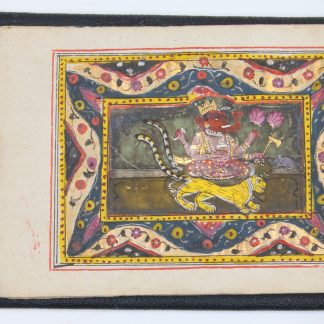
Miniature Bhagavad-Gita manuscript.Probably Kashmir or Punjab / Northern India, ca. 1845 / mid-19th century CE.
€ 18.000,00 -
![Mantiq al-Tayr [The Concourse of the Birds].](https://inlibris.com/wp-content/uploads/2023/03/img-bn60797-324x324.jpg)
Mantiq al-Tayr [The Concourse of the Birds].Shiraz, Persia, 1415 CE = 818 H.
€ 40.000,00
![Kalpasutra [and] Kalikacharyakath [The Book of the Ritual and the Legend of Prince Kalaka].](https://inlibris.com/wp-content/uploads/2025/04/img-bn66658-324x324.jpg)