

Tables from the era that saw the height of Mesopotamia's mathemetical tradition
Cuneiform multiplication table of the number 320.
Clay tablet (48 x 84 mm). 2 sides in Old Babylonian cuneiform.
€ 12.500,00
A cuneiform tablet containing mathematical tables, probably from a school where documents such as this would have been used as teaching aids to be studied and copied out by the students. Here the head number of 320 is multplied by the integers from 1 to 20, and then 30, 40 and 50. It was clearly kept together with other such tablets, as it is pierced through with a hole from side to side to allow it to be bound together with similar ones. In good condition, with the characters clearly and deeply formed, this piece is a testimony to the educational system of the Old Babylonian period, when the study of mathematics reached its high point in Mesopotamian society.
Education was highly valued in the ancient civilisations that flourished between the Tigris and Euphrates, and we have ample evidence of flourishing scribal schools that taught young people how to write in cuneiform. Mathematics were a crucial part of the curriculum, and learning tables and solving problems were part of pupils' lives then much as they are in the modern era.
The Old Babylonian period in particular saw a boom in the study of mathematics, possibly due to an increased emphasis on justice, so as to allow greater exactitude in making fair decisions about divisions of property, etc. Mesopotamian mathematicians made highly advanced discoveries, which were forgotten after the decline of their culture, with later Greek scholars having to labour intensively to work out problems which had already been solved thousands of years before.
The Mesopotamian counting system was sexagesimal, or based on 60, a number which was convenient due to it being easily divisible by 2, 3, 4, 5, 6 or 10. As they wrote numbers and formulated the operations differently than we would today, the Mesopotamian way of doing maths can look quite strange, but they still used the same basic functions that we do today: multiplication, division, square roots, etc.
A handsome testimony to the advanced educational system in Mesopotamian society from a period in which the study of mathematics reached their peak.
London private collection, examined in the 1980s by Prof. Wilfred George Lambert, Fellow of the British Academy and Professor of Assyriology at the University of Birmingham. A copy of his note is included, as is a copy of a note by Dr. Manuel Ceccarelli of the University of Tübingen, who also studied this tablet.
Some minor discolorations and a small patch of surface damage. Hole through the centre from side to side, practically no loss to text. Overall good condition, characters very clearly formed.
CDLI: P519799. Cf. A Podany, Weavers, Scribes and Kings, esp. 310ff.
Ähnlich
-

Cuneiform contract for sale of land for a silver mine.Larsa, Sumer, 1808 BCE.
€ 8.500,00 -
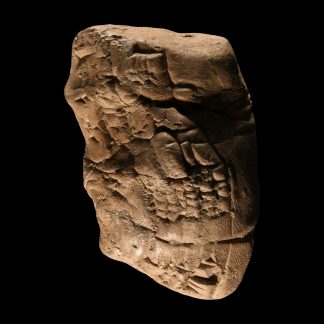
Mesopotamian cuneiform clay tablet.Mesopotamia, early 2nd millennium BCE.
€ 8.500,00 -

Cuneiform foundation cone for the temple Emush.Patibira Tell al-Mada'in, c. 2450-2375 BCE.
€ 35.000,00 -
![Deche di Tito Livio padovano delle Historie Romane [...].](https://inlibris.com/wp-content/uploads/2020/04/img-bn1670-324x324.jpg)
Deche di Tito Livio padovano delle Historie Romane [...].Venedig, 1575.
€ 2.500,00
