

First edition of Heywood's poems, and an early English woodcut book
The Spider and the Flie. A Parable of the Spider and the Flie.
4to (142 x 188 mm). 228 ff. With elaborate decorative woodcut border to title-page, woodcut portrait with decorative border of John Heywood, an additional portrait of the author, 97 woodcuts (26 double-page, all save 1 printed from two blocks), elaborate woodcut tail-piece to each section, decorative initials and text ornaments throughout. Bound in fine red morocco by De Samblancx and Weckesser, boards with elaborate decorative tooling in gilt with fly tools at corners to surround a central geometric spider-web design with central spider, raised bands to spine, tooled and lettered in gilt, board edges ruled in gilt, turn-ins with elaborate decorative tooling in gilt, marbled doublures and endpapers.
€ 55.000,00
First edition of Heywood's illustrated allegorical poems, one of the most extraordinary illustrated printed books of the Tudor era. "The illustrations and decorations as well as the general typographical excellence make this book outstanding among English work of the time" (Pforzheimer 469). Heywood's parable, representing the Catholics as flies and the Protestants as spiders, with butterflies, ants and beetles in attendance, was too much for the contemporary audience, and was not reprinted.
Heywood's "The Spider and the Flie", begun in the 1530s, put aside for twenty years and finally published in 1556, is one of the most extraordinary combinations of illustration and text produced in the Tudor era. The allegorical verse fable, written in over 7,000 lines in rhyme royal, recounts (as well as depicts) the struggles, both rhetorical and literal, of a fly caught in the web of a spider. Heywood's work has often been described as a simple parable of Catholics and Protestants, a mirror of the religious turbulence of the 1500s, but it is rather more complex than that: the various anthropomorphic personifications in the verse, the spider, fly, ant and butterfly, as well as the human characters of the maid and the scholar, symbolize different things in the differing contexts of the verse. There are numerous themes in the book, but Heywood's intellectual references appear to reflect a profoundly sympathetic Humanism very much in opposition to, and with a marked regret for, the sectarian divisions of Tudor religious politics and with similarconcerns to More's 'Utopia'.
The illustrations for "The Spider and the Flie" consist of a series of single-page woodcuts, one for each section of the book, each depicting the window in a library where the drama occurs and the scholar (taken to be Heywood) at the table, with his books, beneath it. The series features small differences from plate to plate, as the insects move across the pane and interact, and it seems likely that there is a significant and detailed symbolism at work here. The most extraordinary illustrations are the double-page examples, printed from one or two blocks, that depict the massed armies and the war that ensues. In these, the artist has in essence zoomed in to the centre of the pane, and displayed the microcosmic action in macrocosm; the scholar is still visible, depicted at the foot of each of these in the left- or right-hand corner. The penultimate plates depict the arrival of the housemaid, the dea ex machina who restores order to the window, while the last depicts the scholar from the rear as if departing the stage.
Heywood (ca. 1497-1578) was a composer, poet, epigrammatist, wit, singer and playwright, he was married to Sir Thomas More's great-niece Elizabeth Rastell and was the grand-father of John Donne. As a composer of interludes, Heywood was active at the court of Henry VIII and all subsequent Tudor monarchs (i.e. Edward VI, Mary and Elizabeth), but not without his own share of controversy and even danger. A Catholic, Heywood served in the household of Mary Tudor in the 1530s, likely introduced by Sir Thomas More, before she was disinherited on the divorce of Henry and Catherine of Aragon. It has been proposed that he began "The Spider and the Flie" for Mary and that the housemaid who appears in the later part of the poem and nine of the woodcuts stands for her. Heywood was arrested in 1543 as part of the plot against Thomas Cranmer, Archbishop of Canterbury, but was pardoned at the scaffold, and despite having performed for Elizabeth and her court, fled into exile in Belgium in 1564 because of his continued Catholicism and the Act of Uniformity.
"'The Spider and the Flie' is an allegorical mock-heroic bestiary in rhyme royal by John Heywood [...] Heywood's poem is nearly as long as Milton's 'Paradise Lost' [...] There is little doubt that the maid of Heywood's poem is Mary Tudor, who attempted to crush Protestantism and restore Roman Catholicism to England, and that Heywood, a devout Catholic, had to wait almost twenty years for religious developments in England to provide him with a suitable conclusion to his poem. The other principals in the poem are less easy to identify, possibly because Heywood sometimes refers to issues and personages in Henry VIII's reign and on other occasions to events in Mary Tudor's. In the first part of the poem the flies seem to represent the commons, the spiders the nobility and rich landowners, and the issue appears to be land enclosures (although not consistently); in the second part the flies appear to be Roman Catholics, the spiders Protestants, and the issue religious conformity. Early in the poem the Fly caught in the web could represent Sir Thomas More and the Spider Cardinal Wolsey; later the crushed Spider suggests Archbishop Thomas Cranmer, executed by the Catholics in 1556. Obscure as Heywood's allegory is, it is nevertheless recognizable as being patently pro-Catholic, an allegation the author was at pains not to publicize until the restoration of Roman Catholicism under Mary Tudor" (Ruoff, Crowell's Handbook of Elizabethan & Stuart Literature).
From the library of Amor L. Hollingsworth with his red morocco bookplate (see also C. F. Libbie, "Catalogue of the magnificent private library of the late Amor L. Hollingsworth", Boston, 12 April 1910, lot 884: "Excessively rare"). Acquired from Goodspeed's Book Shop, 1973, by Charlotte and Arthur Vershbow (their bookplate to front pastedown); Christie's, The Collection of Arthur & Charlotte Vershbow, New York, 9-10 April 2013, lot 2706. Pierre Bergé, Bibliotheque de Pierre Bergé 1ère Partie, Paris, 11 Dec 2015, lot 15.
Title with small marginal repair, second leaf torn and remargined with minor loss of two words, a few tiny holes or short mended tears, I2 and I3 slightly shorter, a few margins trimmed closely.
ESTC S106106. BM-STC 13308. Pforzheimer 469. Brunet III, 152. A Catalogue of the Printed Books collected by Henry Huth (London, 1880) I, 685f. McKerrow & Ferguson 50. Grolier, Langland to Wither, 137. Fact and Fantasy 36.
Ähnlich
-
![Belisar [...]. Aus dem Französischen übersetzt und mit neuen Anmerkungen begleitet. Nebst der glücklichen Familie, einer moralischen Erzählung von eben diesem Schriftsteller.](https://inlibris.com/wp-content/uploads/2020/04/img-bn10670-324x324.jpg)
Belisar [...]. Aus dem Französischen übersetzt und mit neuen Anmerkungen …Leipzig, 1770.
€ 250,00 -
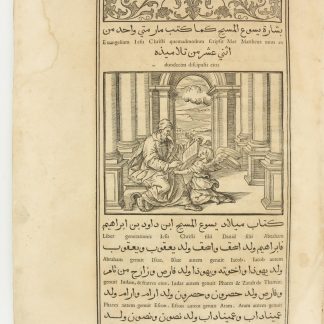
Evangelium Sanctum Domini nostri Jesu Christi conscriptum a quatuor evangelistis …Rome, 1591.
€ 15.000,00 -
Historiarum memorabilium ex Genesi descriptio.Lyon, 1558.
€ 2.500,00 -
![Icones historiarum Veteris Testamenti [...].](https://inlibris.com/wp-content/uploads/2022/03/img-bn57828-324x324.jpg)
Icones historiarum Veteris Testamenti [...].Lyon, 1547.
€ 8.500,00
