

An African miracle of Mary
Miracles of Mary.
265 x 302 mm. Ethiopian manuscript on vellum. 1 p.
€ 3.500,00
An illuminated leaf from a collection of miracles of Mary, depicting her protection of a devout monk. The distinctive story belongs to one of the oldest and most popular miracles of the Virgin recounted in Ethiopian collections, in which it appears from the fifteenth century onwards. At the time this leaf was produced, Ethiopian Orthodoxy was undergoing a crucial resurgence following a period in which Catholicism had been the state religion in Ethiopia due to Portuguese and Spanish influence, and a finely illustrated African miracle story would have resonated in context of the reestablishment of traditional forms of religious authority.
The story describes how in the monastery of Däbrä Qal mon there was a particularly devote monk (here named Salusi) who, although he fasted and prayed assiduously, pretended not to so that he would not be esteemed too highly and thus fall prey to the sin of pride. As the abbot discovered him pretending to eat during a fast, he incited the other monks against him. He duly turned to the icon of the Virgin for assistance, and, when his skullcap fell off and struck the stone, it opened up a passage which allowed him to escape. The monk disappeared and his skullcap became a relic, which, no matter how many times the bishop tried to move it, always returned to its place.
This seventeenth-century leaf dates from the reign of King Fasilädäs (Basilides, 1632-67), when Ethiopian Orthodoxy was being reasserted following an interval when Catholicism had been the state religion. Fasilädäs' father, Susenyos I (1607-32), had embraced the Roman Church in hopes for support from the Spanish and Portuguese in his struggle for the throne, a move that scandalised a country with its own venerable Christian traditions. Fasilädäs ordered the expulsion of the Jesuits, the burning of Catholic religious books, and restored the Ethiopian Church to its traditional position. In this context, a work such as this depicting an African miracle would have had clear political and cultural resonance.
The distinctive nature of this miracle lent itself to pictorial representations, with the Princeton Ethiopian, Eritrean and Egyptian Miracles of Mary Project (PEMM) listing 52 paintings of it in hagiographic manuscripts from the fifteenth century onwards. Another seventeenth-century manuscript, now in the Bibliothèque nationale in Paris (Ethiopien d'Abbadie 114 ff. 71v-72r) also contains an illustration where the monk is identified by the name Salusi. This piece seems to have been painted in the same workshop as a manuscript in the Art Institute of Chicago (Inv. No. 2002.4).
A beautiful piece of Ethiopian Orthodox art from a time of its resurgence.
1) Central London private gallery since 2000s. 2) French private collection.
Deep browning at outer edges, only barely affecting some of the illustrations, a few smaller stains, centre of the page overwhelmingly clean. Verso blank. Illustrations and writing admirably clean and elegant.
Kathleen B. Berzock, The Miracles of Mary: A Seventeenth Century Manuscript (Chicago, 2000). Jacques Mercier et al., L'Arche Ethiopienne: Art Chrétien d'Ethiopie, exhibition catalogue (Paris, 2000), pp. 129f. Jeremy Brown & Ekaterina Pukhovaia, "Monk Pretends Not to Fast", Princeton Ethiopian, Eritrean, and Egyptian Miracles of Mary project (PEMM) 7 (2024).
Ähnlich
-
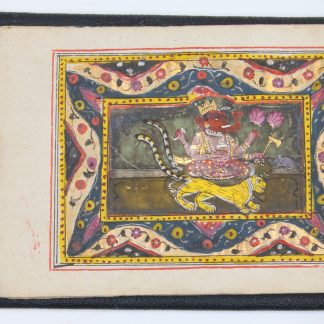
Miniature Bhagavad-Gita manuscript.Probably Kashmir or Punjab / Northern India, ca. 1845 / mid-19th century CE.
€ 18.000,00 -
![[Mets’ihafe negešiti]. The Book of Kings in Ethiopic, containing 1-4 Kings, with diagrams of the Tabernacle and the Ark of the Covenant.](https://inlibris.com/wp-content/uploads/2026/04/img-bn68894-324x324.jpg)
[Mets’ihafe negešiti]. The Book of Kings in Ethiopic, containing 1-4 …Ethiopia, 18th century.
Auf Anfrage -
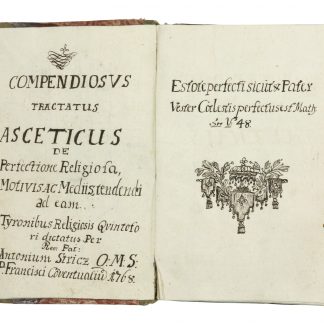
Compendiosus tractatus asceticus de perfectione religiosa, motivis ac mediis …Wohl Österreich, 1768.
€ 350,00 -
![[Manuscript Ge'ez Psalter].](https://inlibris.com/wp-content/uploads/2025/09/img-bn67646-324x324.jpg)
[Manuscript Ge'ez Psalter].Ethiopia or Eritrea, late 18th or early 19th century CE.
€ 3.500,00
