
![Ise Monogatori [The Tales of Ise].](https://inlibris.com/wp-content/uploads/2026/02/img-bn68474.jpg)
![Ise Monogatori [The Tales of Ise]. – Bild 2](https://inlibris.com/wp-content/uploads/2026/02/img-bn68474-a.jpg)
![Ise Monogatori [The Tales of Ise]. – Bild 3](https://inlibris.com/wp-content/uploads/2026/02/img-bn68474-b.jpg)
![Ise Monogatori [The Tales of Ise]. – Bild 4](https://inlibris.com/wp-content/uploads/2026/02/img-bn68474-c.jpg)
![Ise Monogatori [The Tales of Ise]. – Bild 5](https://inlibris.com/wp-content/uploads/2026/02/img-bn68474-e.jpg)
![Ise Monogatori [The Tales of Ise]. – Bild 6](https://inlibris.com/wp-content/uploads/2026/02/img-bn68474-f.jpg)
![Ise Monogatori [The Tales of Ise]. – Bild 7](https://inlibris.com/wp-content/uploads/2026/02/img-bn68474-h.jpg)
![Ise Monogatori [The Tales of Ise]. – Bild 8](https://inlibris.com/wp-content/uploads/2026/02/img-bn68474-j.jpg)
![Ise Monogatori [The Tales of Ise]. – Bild 9](https://inlibris.com/wp-content/uploads/2026/02/img-bn68474-k.jpg)
![Ise Monogatori [The Tales of Ise]. – Bild 10](https://inlibris.com/wp-content/uploads/2026/02/img-bn68474-l.jpg)
![Ise Monogatori [The Tales of Ise]. – Bild 11](https://inlibris.com/wp-content/uploads/2026/02/img-bn68474-m.jpg)
![Ise Monogatori [The Tales of Ise]. – Bild 12](https://inlibris.com/wp-content/uploads/2026/02/img-bn68474-n.jpg)
![Ise Monogatori [The Tales of Ise]. – Bild 13](https://inlibris.com/wp-content/uploads/2026/02/img-bn68474-o.jpg)
![Ise Monogatori [The Tales of Ise]. – Bild 14](https://inlibris.com/wp-content/uploads/2026/02/img-bn68474-p.jpg)
![Ise Monogatori [The Tales of Ise]. – Bild 15](https://inlibris.com/wp-content/uploads/2026/02/img-bn68474-q.jpg)
![Ise Monogatori [The Tales of Ise]. – Bild 16](https://inlibris.com/wp-content/uploads/2026/02/img-bn68474-r.jpg)
![Ise Monogatori [The Tales of Ise]. – Bild 17](https://inlibris.com/wp-content/uploads/2026/02/img-bn68474-s.jpg)
![Ise Monogatori [The Tales of Ise]. – Bild 18](https://inlibris.com/wp-content/uploads/2026/02/img-bn68474-t.jpg)
![Ise Monogatori [The Tales of Ise]. – Bild 19](https://inlibris.com/wp-content/uploads/2026/02/img-bn68474-u.jpg)
![Ise Monogatori [The Tales of Ise]. – Bild 20](https://inlibris.com/wp-content/uploads/2026/02/img-bn68474-v.jpg)
![Ise Monogatori [The Tales of Ise]. – Bild 21](https://inlibris.com/wp-content/uploads/2026/02/img-bn68474-w.jpg)
![Ise Monogatori [The Tales of Ise]. – Bild 22](https://inlibris.com/wp-content/uploads/2026/02/img-bn68474-x.jpg)
![Ise Monogatori [The Tales of Ise]. – Bild 23](https://inlibris.com/wp-content/uploads/2026/02/img-bn68474-y.jpg)
![Ise Monogatori [The Tales of Ise]. – Bild 24](https://inlibris.com/wp-content/uploads/2026/02/img-bn68474-za.jpg)
![Ise Monogatori [The Tales of Ise]. – Bild 25](https://inlibris.com/wp-content/uploads/2026/02/img-bn68474-zb.jpg)
![Ise Monogatori [The Tales of Ise]. – Bild 26](https://inlibris.com/wp-content/uploads/2026/02/img-bn68474-zc.jpg)
![Ise Monogatori [The Tales of Ise]. – Bild 27](https://inlibris.com/wp-content/uploads/2026/02/img-bn68474-ze.jpg)
![Ise Monogatori [The Tales of Ise]. – Bild 28](https://inlibris.com/wp-content/uploads/2026/02/img-bn68474-zf.jpg)
![Ise Monogatori [The Tales of Ise]. – Bild 29](https://inlibris.com/wp-content/uploads/2026/02/img-bn68474-zg.jpg)
![Ise Monogatori [The Tales of Ise]. – Bild 30](https://inlibris.com/wp-content/uploads/2026/02/img-bn68474-zh.jpg)
![Ise Monogatori [The Tales of Ise]. – Bild 31](https://inlibris.com/wp-content/uploads/2026/02/img-bn68474-zi.jpg)
![Ise Monogatori [The Tales of Ise]. – Bild 32](https://inlibris.com/wp-content/uploads/2026/02/img-bn68474-zj.jpg)
![Ise Monogatori [The Tales of Ise]. – Bild 33](https://inlibris.com/wp-content/uploads/2026/02/img-bn68474-zk.jpg)
![Ise Monogatori [The Tales of Ise]. – Bild 34](https://inlibris.com/wp-content/uploads/2026/02/img-bn68474-d.jpg)
![Ise Monogatori [The Tales of Ise]. – Bild 35](https://inlibris.com/wp-content/uploads/2026/02/img-bn68474-g.jpg)
![Ise Monogatori [The Tales of Ise]. – Bild 36](https://inlibris.com/wp-content/uploads/2026/02/img-bn68474-i.jpg)
The first Japanese illustrated book: a masterpiece of the Saga-bon
Ise Monogatori [The Tales of Ise].
4to (194 x 270 mm). 2 volumes. 51; 64 ff., sewn fukuro-toji style. Text printed from wooden movable type on gampi paper in five colour shades, 9 lines per page, 16-18 'ji' characters per line. With a total of 49 sumizuri woodcuts in the yamatoe style (25 in vol. 1, 24 in vol. 2). Original mauve covers with faint mica-printed foliage and centred title-slips, block-stitched with thread. Stored in custom-made cloth chitsu case.
The first printed edition of the popular "Ise Monogatari" (or "Tales of Ise"). Published by Suminokura Soan (1571-1632), a wealthy entrepreneur, scholar, and art connoisseur, this is the first work of Japanese literature to be illustrated with woodcuts, and also one of the earliest to be printed with moveable type, a technique then newly imported from Korea.
Soan’s printing establishment, a luxury private press set up at Saga village near Kyoto, produced the much sought-after "Saga-bon" imprints, famous for their beautiful hiragana type modelled on the script of Hon'ami Koetsu, a renowned painter, calligrapher and polymath. Of all productions of that press, this 1608 first edition of the "Ise Monogatari" is the most highly prized. First issues such as the present one are identified by the autograph signature (or 'kakihan') of the scholar-editor below the printed colophon, probably indicating that these copies were presented as gifts: "Sozen" is the name which Nakanoin (1558-1610) assumed as a Buddhist priest. Unusually, it is written over a variant, Buddhist version of his seal as "Yasoku", which may indicate that this was a gift for his Zen Master.
The "Tales of Ise" constitute an anonymous medieval compilation of poems and episodes from the life of an unnamed lover-poet. Enormously popular, these amorous exploits have been considered a kind of Japanese 'ars amatoria'; they had long been a popular subject matter for manuscript illustration, and so it is little surprise that they would be chosen for the first illustrated Japanese printed book. These 49 woodcuts, the earliest examples of Ukiyo-e illustration, would serve as models for much Japanese art which followed. The illustrator is unknown, but some have attributed the cuts to Koetsu.
Printed on gampi paper of a specially sumptuous consistency, equivalent in prestige to the parchment used in Europe, but of a softer, more absorbent texture. The sheets were dyed with five different colours to evoke the luxury and resplendence of the medieval Heian period.
Very few copies of the first issue were made. The only recorded copy sold at auction in the West within the last half century was a specimen from the Donald and Mary Hyde collection (with manuscript kakihan), sold by Christie's in 1988 for the benefit of the Morgan Library. It is believed to have been purchased by the famed bookseller Shigeo Sorimachi on behalf of Oyama College. In Japan, copies with manuscript kakihan are found at the Kyoto University Library, Goto Museum, Toyo Bunko Library, and Tohoku University Library. One copy was acquired by the University of Illinois in 2012, to commemorate the 13 millionth book in their library; another is in the Spencer Collection of the NYPL. The present copy is superior to that in the British Library, which has been rebound, Western-style, in one volume. Another copy exists at the Östasiatiska biblioteket in Sweden, and one more in Cambridge University Library (a later issue, printed from a woodblock rather than movable type).
1. Takehiko Sakai (Isseido Booksellers).
2. Colin Ellis Franklin (1923-2020), Culham (purchased Tokyo, 2000).
3. French private collection (acquired January 2013).
Covers rubbed with expected handling to the paper over-boards; sewing sound. Occasional light toning and scattered marginal spots; impressions of the woodcuts strong; title-slips preserved.
K. Kawase, Illustrated Study of the Saga Books (Tokyo, 1932), pp. 23-41 & plates 7-27. Ibid., Kokatsuji-ban no kenkyu (3 vols., Tokyo, 1967). K. B. Gardner, Descriptive Catalogue of Japanese Books in the British Library Printed Before 1700 (London, 1993), pp. 71f., 313f. K. Toda, Descriptive Catalogue of Japanese and Chinese Illustrated Books in the Ryerson Library of the Art Institute of Chicago (1931), pp. 14-16. W. Strauss & C. Bronze, Japanese Woodblock Book Illustrations (New York, 1979-82) I, pp. 11-60. F. Rumpf, Das Ise Monogatari von 1608 und sein Einfluß auf die Buchillustration des 17. Jahrhunderts in Japan (Berlin, 1931).
Ähnlich
-
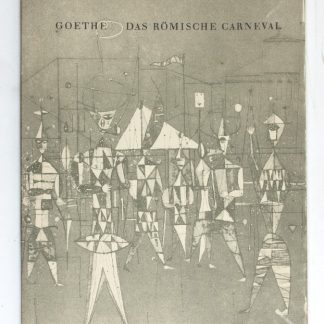
Das römische Carneval. Mit farbigen Radierungen von Rudolf Kügler.Hamburg, 1958.
€ 180,00 -

Poèmes illustrés par Salvador Dali.Paris, 1967.
€ 15.000,00 -

The Portraits of the "Forty-Seven Ronins" with the Biographical Sketch …Yokohama, Meiji 18 1885.
€ 3.500,00 -

Ansichten von Frankfurt am Main und seiner Umgegend.Frankfurt am Main, 1818.
€ 12.500,00