


"Where in Europe would one find an eighth-century manuscript, with known provenance from the twelfth century onwards?”
Daihannya sutra scroll. Vol. 168.
Manuscript scroll (26 x 817 cm). Chinese text in black ink on yellow-dyed kozo paper (kihada). 1 scroll (vol. 168), 17 characters per column; complete. Stored in a fitted wooden case.
A complete volume (168) of the famous Mahaprajnaparamita Sutra, measuring more than eight metres; sister volumes survive in major institutional collections. Copied in an accomplished black hand on insect-repellent yellow-dyed kozo paper (kihada) in the late eighth century.
The Daihannya was among the most widely transmitted Mahayana texts in East Asia, and in Japan its copying and recitation became a state-sponsored technology of protection, merit, and ritual efficacy; the crisp, even columns here reflect the disciplined aesthetics of early temple scriptoria. The red punctuation and reading marks are attributable to the celebrated Kofukuji monk Eion (1167 - after 1233) and are dated by the colophon to 1232; they materially document the continued liturgical and scholastic use of the scroll in medieval Nara.
In 1232 the scroll formed part of Eion's donation of the 600 Daihannya volumes to Kofukuji, an act of institutional consolidation that linked the great Nara monastery’s doctrinal authority with the enduring prestige of early manuscript transmission. Colin Franklin, describing comparable Nara-period examples of the same tradition, noted that "Such scrolls have three marvellous qualities: antiquity, calligraphy and paper", and, quoting Christopher de Hamel, asked: "where in Europe would one find an eighth-century manuscript, with known provenance from the twelfth century onwards?" At an unknown later date the scroll entered the holdings of the Kunitama Shinto Shrine (Osaka), a typical trajectory in which Buddhist manuscripts moved into shrine libraries as ritual and documentary objects in a mixed cultic environment.
Other recorded survivors from this same 600-scroll set include volumes 514 and 522 (Kyoto National Museum; Registered Important Cultural Property) and volume 244 (Harvard University Art Museums, Arthur M. Sackler Museum), underscoring the long, fragmentary dispersal of monumental temple sets and the exceptional longevity of Japanese manuscript culture.
1. Kofukuji (Nara), from the donation of Eion, dated 1232.
2. Kunitama Shinto Shrine (Osaka).
3. Isseido Booksellers (Tokyo), sold April 2014 (invoice).
4. French private collection.
Usual expert Japanese restoration and mounting; minor handling wear and light age-toning; well preserved.
Colin Franklin, Collecting Japanese Books and Scrolls (San Francisco, 1999), pp. 25f. and plate 8.
Ähnlich
-
![Daihannya-kyo [Mahaprajnaparamita sutra]. Vol. 19.](https://inlibris.com/wp-content/uploads/2026/03/img-bn68877-324x324.jpg)
Daihannya-kyo [Mahaprajnaparamita sutra]. Vol. 19.Japan, Nara, early Kamakura period 1222-1227.
Auf Anfrage -
![Minhaj al-'Abidin [Methodology for the Worshippers].](https://inlibris.com/wp-content/uploads/2020/05/img-bn47072-324x324.jpg)
Minhaj al-'Abidin [Methodology for the Worshippers].Probably Persia Qazvin province?, 3 April 1741 CE = 16 Muharram 1154 H.
€ 1.500,00 -
![Sokushingi Mitsudan-sho bassui [Extracts from Notes on the Esoteric Discussion of the Sokushin-gi].](https://inlibris.com/wp-content/uploads/2026/03/img-bn68875-324x324.jpg)
Sokushingi Mitsudan-sho bassui [Extracts from Notes on the Esoteric Discussion …Japan, 1352 CE = Shohei 7.
€ 110.000,00 -
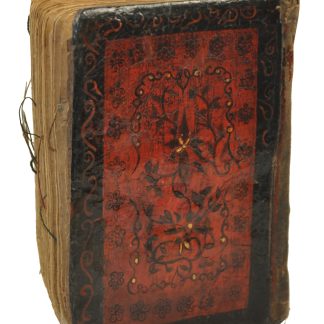
Dala'il al-khayrat ("Waymarks of Benefits").Eastern Turkestan, now Xinjiang, China, early 17th century CE.
€ 38.000,00