

A lost leaf from a rare Coptic text
On Christian Behaviour.
Fragment (249 x 266 mm). 1 f. Sahidic Coptic manuscript on vellum.
€ 35.000,00
A rare rediscovered leaf from one of only two known manuscripts of an original Coptic text from the first millennium CE, when it was at its peak as a literary language. Attributed to the great Abbot Shenoute, a central figure of Coptic spirituality and literature, the text provides exhortations and examples for persons at all levels of society to live a Christian life. Commissioned by a woman for a convent of nuns in Fayoum in the Coptic year 715 (998-999 AD), it provides evidence of female piety in Egypt's medieval Christian community.
Containing two columns of text in a clear Sahidic uncial script, the leaf is numbered at the top right, marking it as one of the leaves lost from the manuscript now known as British Library, Or. 12689. This and 3 other leaves (numbered - ) went missing from the manuscript sometime between 1920 and 1961, when it came into the Library's possession. The dimensions and condition are in keeping with the volume as a whole. The only other known manuscript of the text is in the Morgan Library (M 604); this leaf thus offers new insight into the contents of a rare Coptic text.
Another lost leaf, which appeared on the market in 1992, contained a colophon giving the year of the manuscript's production as 715 (998-999 AD) and stating it was donated by a woman to the Convent of the Virgin Mary at Pilgasook (mod. Bouljouzook) in Fayoum.
The Archimandrate Shenoute (d. 466) was Abbot of the famous White Monastery, which possessed one of the greatest libraries of Christian Egypt. While many earlier Coptic texts were primarily translations from the Greek, Shenoute was famed for his exquisite style which many saw as elevating Coptic to its literary peak. As "On Christian Behaviour" is written in a fairly straightforward manner, its attribution to Shenoute has been called into question; nonetheless, its linguistic features still distinguish it as a text originally composed in Coptic.
The descendant of the ancient Egyptian language of the Hieroglyphs, Coptic began to be written in the Greek alphabet in with additional characters derived from Demotic Egyptian in the first few centuries AD. Although many early texts were translations from Greek, Coptic came to be used for original compositions, notably during the early Christian period when Egypt was the cradle of monasticism. Notable figures who wrote in Coptic include Anthony the Abbot, Pachomius and Athanasius. By the ninth century it had entered a period of literary decline, as it was increasingly sidelined by Arabic, but it remains the liturgical language of the Egypt's Coptic Church to this day.
A unique find offering a glimpse into Coptic female piety and a rare text from Christian Egypt.
1) While still bound with what is now British Library Or. 12689, offered for sale by a Cairo dealer to J. P. Morgan in 1916 (and declined).
2) Purchased by the Paris dealer Alexandre Imbert, 1920.
3) This and at least 3 other leaves were separated from 12689 sometime between 1920 and 1961, when the latter was sold by Sotheby's to the British Library.
4) Connecticut private collection.
5) Sold at Lark Mason Auctions, New York.
6) Christie's, Sale 21033, 13 July 2022, Lot 1.
7) European private collection.
Edges frayed and singed, page incomplete with some loss of text. Some staining and ink erosion but text overall clear and legible. Binding string preserved on reverse and fragments of adhesive at top.
Wolfgang Cosack (ed. & trans.), Shenoute of Atripe: de Vita Christiana (2013); cf. K. H. Kuhn (ed. & trans.), Pseudo-Shenoute: On Christian behaviour (1960). Cf. British Library, Or. 12689. Cf. Morgan Library, M 604. Cf. Christie's, Illuminated Manuscripts, Autograph Letters, Valuable Printed Books and Historical Bindings, London, Wednesday, 25 November 1992, Lot 32.
Ähnlich
-
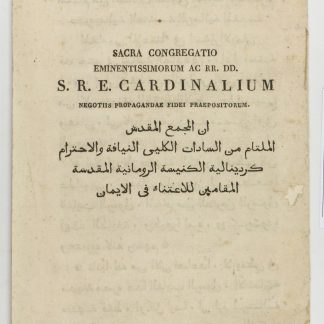
Sacra Congregatio Eminentissimorum ac RR. DD. S. R. E. Cardinalium negotiis …Rome, 1830.
€ 1.500,00 -
Eigenh. Manuskript mit Namenszug in der Eingangszeile.O. O. u. D.
€ 600,00 -

A woman's mummy mask made of inscribed papyri with a winged scarab.Egypt, Ptolemaic period late 2nd to early 1st century BCE.
€ 75.000,00 -
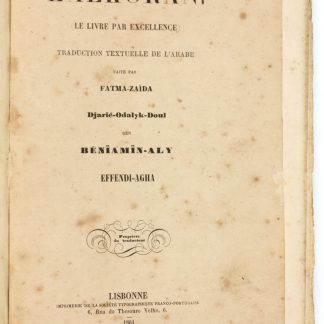
L'Alkoran! (Le livre par excellence.) Traduction textuelle de l'arabe faite …Lisbon, 1861.
€ 4.800,00
