Magnificent first-issue Nuremberg Chronicle in broad margins
Liber Chronicarum.
Folio (311 x 473 mm; leaves 300 x 452 mm). 325 ff. (of 326, wanting only the final blank), gothic type, 64 lines plus headlines, partly in two columns. With xylographic title-page and 1809 woodcuts by Wolgemut and Pleydenwurff, including 1164 repeats; double-page woodcut maps of the world and of Europe. Five unnumbered leaves "De Sarmacia" bound after fol. 266; with the three blank leaves 259-261 for manuscript additions to the world history. 19th century English brown morocco, sides panelled in blind with a lozenged frame and blind-stamped fleur-de-lys, spine lettered in gilt.
€ 85.000,00
First edition of the Nuremberg Chronicle, and a superb first-issue copy of Hartmann Schedel's "Liber Chronicarum", distinguished by the celebrated state in which the capital A on ff. 257v-258r is omitted in type and supplied by hand. The present copy is further remarkable for its strong, dark impressions, fresh rubrication, and notably ample margins.
Probably the most ambitious publishing venture of the fifteenth century, the Chronicle united Anton Koberger’s international press enterprise with the designs of Michael Wolgemut and Wilhelm Pleydenwurff to produce the most celebrated illustrated book of the incunable period. Its 645 blocks, here printed 1809 times, encompass biblical history, genealogy, city views, maps, saints, prodigies, and the visual rhetoric of universal history on an unprecedented scale.
Schedel compiled the text from a broad humanist library, but the work's real historical agency lies in the synthesis of learned chronicle and image programme: it transformed the world chronicle into a monumental printed object of European reach. Published in July 1493, it also stands among the last comprehensive world surveys conceived before the discovery of the New World entered the printed historical imagination.
The Chronicle’s fame rests especially on the richness and ambition of its woodcut cycle, whose workshop association with Wolgemut, Pleydenwurff, and possibly the young Dürer places the book at the centre of late 15th-century Nuremberg art and commerce. Its immediate success is reflected in the pirated Augsburg reissues that followed within only a few years.
This copy preserves the desirable early state identified by Christopher de Hamel, with manuscript-supplied capitals where Koberger temporarily lacked the relevant sort. Handsomely rubricated in red and blue by a contemporary hand, and preserved in an imposing later English morocco, it remains a magnificent, wide-margined example of one of the defining monuments of early European printing.
1) Bibliotheca Eechoutana, with inscription on the title-page.
2) Major William Arnold, Tonbridge, bought from Robert D. Steedman in 1939, with engraved bookplate “Sic vita humana”.
3) Laurence Witten Rare Books, 1981.
4) Sotheby’s New York, 23 October 1987.
5. Margaret Winkelman, with book-label.
6) Bloomsbury, 11 June 2007, A Private Collection of Illustrated Books, XV-XX Centuries.
Title-page creased. First few margins somewhat soiled and with a single wormhole. Short marginal tears to leaves [9], 116, and 188, not affecting text. Blank corner of leaf 33 torn away without loss. Some light marginal dampstaining at end. Map of Europe slightly shaved at left margin, mounted on a stub, with minor restoration and small pen facsimile at the inner fold. Binding rubbed.
H 14508. Goff S-307. GW M40784. Cockerell 86. Proctor 2084. BSB-Ink S-195. BMC II, 437. Schreiber 5203. Fairfax Murray 394. Schramm XVII, 9. Klebs 889.1. Oates 1026. Shirley 19.
Ähnlich
-
![[Vitas patrum - germanice]. Der altväter leben.](https://inlibris.com/wp-content/uploads/2024/02/img-bn63401-324x324.jpg)
[Vitas patrum - germanice]. Der altväter leben.Augsburg, 25.09.1482.
€ 140.000,00 -

Hypnerotomachia Poliphili, ubi humana omnia non nisisomnium esse docet …Venice, Dec. 1499.
€ 350.000,00 -
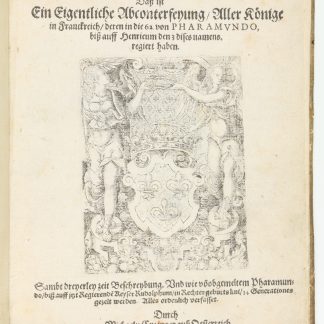
Iconographie regum Francorum. Daß ist ein eigentliche Abconterfeyung, …Cologne, 1587.
€ 3.500,00 -

[Missale.Eichstätt, 1486.
€ 6.500,00