


A French playwright's commonplace book
Recueil de pieces choisies.
Small folio (196 x 305 mm). (2), (139) pp., (17) blank pp. French manuscript on paper, written per extensum save for a left margin indicated in pencil. Brocade boards with a gilt tendril design; red morocco spine with gilt title.
€ 3.500,00
A compilation manuscript of poetic and historical rarities from the library of the eighteenth-century man of letters Louis de Laus de Boissy, a correspondent of Voltaire whose work spanned the pre- and post-revolutionary periods. Many of these pieces are difficult to locate and may be unpublished, making this an individual collection of sources for the political history and literary culture of seventeenth-century France.
This volume bears the bookplate of "M. De Laus de Boissy, Ecuyer, Lieutenant-particulier du Siège de la Connétablie, Rapportuer du Point-d'Honneur; Membre des Académies de Rome, Padoue, &c. &c.". Laus de Boissy was appointed to the Royal Constabulary (Connétablie) in 1766, and the royalist association of the title would have made him unlikely to use it after the beginning of the Revolution, which provides us with a temporal framework for this volume. Written in a fine eighteenth-century hand, it was examined and annotated by a reader in the nineteenth century, who added cross-references to printed editions and other related works to some pieces.
The selections are wide-ranging, from drama to poetry to accounts of travels, military campaigns and the political history of France in the seventeenth century. A particular interest is shown in Burgundy, as evidenced by "Lou veritable Vey de Gôdô", a seventeenth-century poem in Burgundian dialect, and an account of a journey to Besançon in 1699 by Soyrot, comptroller-general of finances of Burgundy, written in a mix of prose and verse.
A considerable number of pieces, grouped at the end of the work, relate to the execution of Henri, Duc de Montmorency in Toulouse in 1632. A member of one of France's most powerful households and a successful military commander, Montmorency attracted the jealosy of Cardinal Richelieu, against whom he later led a failed rebellion which led to his execution.
Louis de Laus de Boissy was known as a dramatist and author of barbed verses who produced several plays and a history of French literature. He often wrote under the pseudonyms "Mademoiselle M. de Morville" and "un homme de mauvaise humeur". Following the Revolution, he was made a judge in the Seine départment.
An individual collection of rarities reflective of the wide-ranging interests of a prolific man of letters.
Engraved bookplate of Louis de Laus de Boissy (1743-1799) to front pastedown.
Title; contents; 1. (1-21) Les Moines, 1709; 2. (22-25) Epithalame de Madame d'Antin; 3. (25) Sonnet for the same, 1686; 4. (26-38) Dialogue sur le Quiétisme par l'Abbé Fléchier (1700); 5. (38-46) La Macette, Satire XIII par Regnier (1609); 6. (46-49) Plainte de Madame sur le départ de Monsieur son Epoux, pour la guerre d'Allemagne; 7. (50-54) Lou veritable Vey de gôdô (in Burgundian dialect, attributed to Malpois, c. 1620); 8. (55-66) Relation d'un voyage de Besançon à M. Bouhier de Savigny par M. Soyrot (1699); 9. (66-69) Portrait de M. de Turenne; 10. (70-73) Recit de la mort de Madame Henriette d'Angleterre, Duchesse d'Orleans, par le Sieur Feuillet; 11. (73-75) L'une des Relations que le Roy envoya à la Reine écrite de sa main au camp devant Tolluits sur le bord du Rhin (1672); 12. (75-79) Detail des Ceremonies du Mariage de la Reine d'Espagne, faites à Fontainebleau (1679); 13. (79-82) Recit de la mort de M. le Prince Louis de Bourbon (1686); 14. (83-112) Apologie de M. le Cardinal de Bouillon (d. 1715); 15. (112-119) Histoire de Chilperic Roi de France, de Luitprand, et d'Ogine (unknown); 16. (119-130) Relation de ce qui s'est passé à Toulouse sur la fin du mois d'Octobre 1632 à l'execution de la personne de M. le Duc de Montmorancy. 17. (130-131) Extrait d'une lettre escrite par un Pere Jesuite de Toulouse sur la mort de M. de Montmorancy. 18. (131-139) Nine other pieces, mostly poems, on the death of Montmorancy. 17 pp. blank. Nos. 2, 3, 6, 8, 10 and 13-18 (aside from "Mars est mort" and "Le Duel Aboly") cannot be located on Gallica in either print or manuscript.
Boards rubbed and edgeworn; spine rubbed, chipped at ends. Pages with some foxing and staining, mild browning commensurate with age, pages regularly creased for use in columns. Writing clean and clear, with marginal annotations and corrections by at least two hands. An attractive volume for its age.
Ähnlich
-
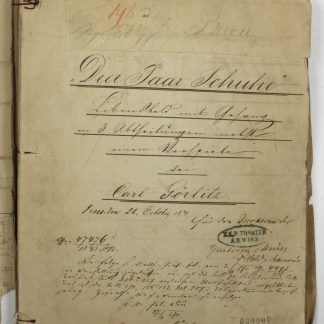
"Drei Paar Schuhe. Lebensbild mit Gesang in 3 Abtheilungen nebst einem …Wien, Februar 1870.
€ 150,00 -
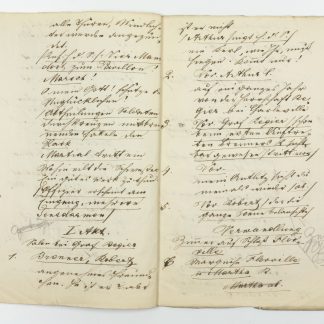
"Scenarium von Licht und Schatten Schauspiel in 4 Acten, nebst einem Vorspiel …O. O. u. D., wohl um 1860-1870.
€ 40,00 -

Eigenh. Briefkonzept.O. O. u. D., um 1829.
€ 6.500,00 -
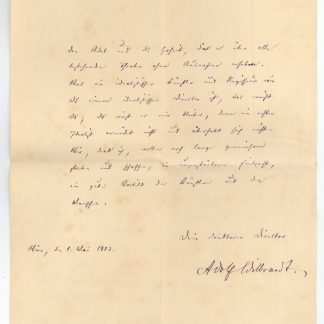
Eigenh. Brief mit U.Wien, 01.05.1883.
€ 120,00
