

A foundational element in the development of written language
Roman inked wooden tablet.
Rectangular wooden (probably cedar) tablet, ca. 145 x 79 mm (lower half absent without loss of text), 12.4 grams. 5 lines of legal text, written in Roman cursive script by two hands with in dark ink on one side only; a recessed slot to the reverse. A reused tablet with a recessed panel on one side, forming the last tablet of a legal document which consisted of two or three tablets.
€ 85.000,00
One of the earliest extant documents in world history to be written in ink: a writing tablet from the Roman province of Numidia with script in Roman cursive. Soon adopted throughout the later Roman Empire, the style became a foundational element in the development of written language in Western Europe and the ultimate precursor of all subsequent medieval minuscules, including our own lower-case alphabet.
Roman writing tablets were a crucial medium of communication in antiquity. Typically made from oblong pieces of wood pieces, they usually had a wax surface that was inscribed with a stylus. While the vast majority of ancient writing tablets is lost, examples of such wax slates ("tabulae ceratae") were discovered in Pompeii, and between 2010 and 2013 a significant collection was unearthed in London's financial district, dating from 50 to 80 CE.
Inked tablets, by contrast, are vastly less common than their wax counterparts. A trove of these remarkable slates was discovered in the fort of Vindolanda, south of Hadrian's Wall; each tablet is approximately the size of a modern postcard, and similarly thin. These specimens, now in the British Museum, are considered the earliest known surviving instances of ink-written letters from the Roman era.
The ink tablet at hand, however, represents a third group, the rarest of them all. The closest example are the "Tabulae Albertini", cedar wooden tablets which are larger and thicker than those from Vindolanda. Written in Northern Africa in the late 5th century CE, they were discovered in the region of Tébessa, Algeria, in 1928. The present tablet, however, is roughly a century older, based on its letter forms, and although it has been reused, the recessed area never held any wax. No traces from earlier writing with a stylus are evident, so the previous text was probably washed off - a common practice with the ink tablets.
In his Historia Naturalis (book 35, §25), Pliny gives a classic account of "atramentum" ("ink", or literally, "blacking"), describing it as a mineral "made from soot in various forms, as (for instance) of burnt rosin or pitch ... The ink of the very best quality is made from the smoke of torches. An inferior article is made from the soot of furnaces and bath-house chimneys. Some manufacturers employ the dried lees of wine ... Polygnotus and Micon, celebrated painters at Athens, made their black paint from burnt grape-vines ... The dyers make theirs from the dark crust that gradually accumulates on brass-kettles. Ink is made also from torches (pine-knots), and from charcoal pounded fine in mortars ... Book-writers' ink has gum mixed with it, weaver's ink is made up with glue. Ink whose materials have been liquified by the agency of an acid is erased with great difficulty".
The text, written in formulaic legal language, forms the last part of a (probably marriage) contract which would originally have been written on two or three tablets (forming a diptych or even a triptych). This final piece includes the statement of signature: "Rogatianus, pater sponsi, subscripsi".
Acquired in 1950 from a collector in Bône (Annaba), Algeria, by Albert A. Sfez, who moved to France, and then to Belgium, in 1962. Gifted to his son, Alain Claude Sfez, in 1965. Sold in 1973 to the noted numismatist, Byzantinist and dealer Michael Dennis O'Hara of Brussels/London. In turn sold in 1975 to Derrick Dean of Carshalton, south London (d. 1997). Gifted to or inherited by Derrick Dean’s son, Timothy Dean, and purchased from him by the last owner.
One tablet of a document which consisted of two or three pieces; pierced once in the upper rim for attachment. Right and left edge slightly irregular, following the wood grain, upper edge straight; lower edge fairly straight, broken off along the grain. Accompanied by a collection of six 1970s photographs of the tablet.
Published in: Peter Rothenhöfer, Neue römische Rechtsdokumente aus dem Byzacena-Archiv / New Roman Legal Documents from the Byzacena Archive (forthcoming). Cf. Peter Rothenhöfer, Jürgen Blänsdorf, "Sana mente sanaque memoria testamentum feci: Eine testamentarische Verfügung vom 12. April 340 n. Chr.", Gephyra 13 (2016), pp. 153-163; Peter Rothenhöfer, "Neues zum Testament des Pomponius Maximus aus dem Jahr 371 n. Chr." (forthcoming). See also Carla Masi Doria, "Dal testamento di Pomponius Maximus: prospettive del diritto ereditario tardo antico", in: Lisa Isola (ed.), Klauselgestaltungen in Römischen Testamenten (Berlin, 2022), pp. 151-175; J. D. Thomas, Vindolanda: The Latin Writing Tablets, Britannia Monograph Series No. 4 (London, 1983) for examples of wooden tabulae re-used as writing surfaces. For examples of testamentary documents on wooden tablets that have survived, see FIRA III, p. 47; for Anthony Silvanus from 142 AD; also see BGU VII 1695 for Safinnius Herminus; for another from Transfynydd, North Wales, see Arch. Camb. 150, pp. 143-156; and see A. K. Bowman, Life and letters on the Roman frontier: Vindolanda and its people (London, 1994) for discussion of the uses of Roman writing tablets.
Ähnlich
-

Autograph letter signed, on papyrus.Egypt, early to mid-4th century ca. 330-340 CE.
€ 185.000,00 -

Contract between Maianus and Silvanus.Titiunum, Byzacena, Roman North Africa, c. 301-350.
€ 65.000,00 -
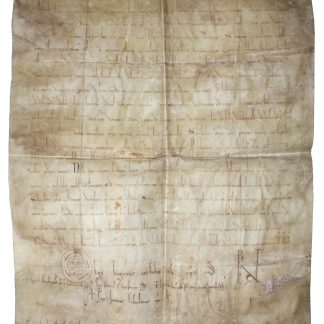
Papal bull.Altissiodorum Auxerre, 26.09.1147.
€ 45.000,00 -

Contract between Crescentius and Ianuarius.Goretianum, Byzacena, Roman North Africa, c. 301-350.
€ 45.000,00
