

A fourth-century papyrus letter by a leader of gnostic women's circle
Autograph letter signed, on papyrus.
Single papyrus leaf, 219 x 103 mm. 20 lines in Greek, written in dark-brown ink in a single hand on the recto, across the fibers, with address on verso. Written in an upright and regular hand, letters well formed and generally detached; few ligatures. The language of the letter is straightforward and simple; phonetic spellings are numerous but unremarkable. Stored in a custom cloth box.
€ 185.000,00
Arguably one of the most famous early letters written by a woman, first brought to light in the 18th century and only recently released from institutional custody: an extraordinary opportunity to acquire a fourth-century document always considered beyond reach. It is written to a female recipient Atienateia, who still has a balance of 1,300 denarii to her credit, urging her to indicate any further wants.
Didyme refers to herself and "her sisters in the Lord", a formula indicating that the writer is a Christian; indeed, recent scholarship has argued convincincly that writer and recipient probably share a gnostic background in which eminent women were leaders of female religious and spiritual circles. The letter reads translated, in full:
"To my lady sister Atienatia, Didyme and the sisters send greetings in the Lord. First of all it is necessary to greet you, praying that you are well. Write to us, my lady, concerning your health and whatever orders you need, with full liberty. Let us know if you received your orders. There is a balance with us from the money of your orders, I believe, of 1,300 denarii. Canopic cakes received for you from them will be dispatched. Greet my blessed lady sister Asous and her mother and [...]" (addressed on the verso: "To my lady sister Atienateia, Didyme with the sisters").
The Roman denarius currency is a sign of the early fourth-century date; the sum is equal to 5,200 drachmas. In the 1920 edition of Grenfell & Hunt (The Oxyrhynchus Papyri XIV, London 1920), the hand was judged to be "early fourth century", but more recent research has tended to place it a little later, towards the middle of the century. The use of "in the Lord" with "K[yri]o" abbreviated as a nomen sacrum, in the manner of Christian texts, shows that the author is a Christian.
This is one of two surviving letters from Didyme and the sisters (the other being SB 8.9746, which is written to another woman, Sophias). The letters have given rise to speculation about the milieu in which they were produced, and specifically the mention of "the sisters" has engendered considerable debate whether Didyme was the head of a group of female Christian ascetics (cf. Elm, pp. 236f., 241-244; Wipsyzcka). In the present text, the only persons mentioned are female, unlike in SB 8.9746. The women have been described as engaged in business, but their activities - receiving and sending produce, food, and clothing - do not appear to differ materially from those described in ordinary family letters. Particularly important has been the question whether "sisters" and "brothers" in these texts are to be taken as normal kinship terms (even if not necessarily denoting a common father and mother) or as references to a common membership in Christian communities, particularly of a monastic kind. That they come from a Christian milieu is clear enough, and while the plural forms in the opening are not paralleled elsewhere in family letters, scholarship has for several decades been circumspect in its inferences: "While caution is advisable, the evidence favours a community of women and men who are not relatives and are united by other than business interests alone: at the very least by their shared Christianity, but perhaps by ascetic principles as well … For the present this somewhat vague conclusion has to suffice, but the two papyri have presented us with a potential model of ascetic life for women, aspects of which might reappear in literary sources" (Elm, pp. 236-244).
More recently, Fritz Mitthof of Vienna has shed new light on the background of these women, demonstrating that the 'Didyme' letters are of even greater religio-historical and historico-cultural importance than has long been recognized. He is able to show that several names in Didyme's companion letter which were long thought to be male are in fact female (in the neuter form), and that Didyme must have been one of several eminent women who led separate spiritual circles. He further points out that many of these women's names are clearly not given, but consciously adopted, and "the most prominent of these names are linked to the word 'sophia', which probably indicates that these female communities had a gnostic background" (p. 37).
1) Egypt Exploration Society.
2) Palestine Institute Museum, Pacific School of Religion, Berkeley, California. De-accessioned by the PSR in 2013 as part of the sale of the Howell Collection of Bibles and other theological rarities in their collection.
3) John Windle, San Francisco.
4) UK private collection.
Complete except at the bottom.
P.Oxy. 14.1774. Bagnall/Cribiore, Women's Letters (2006), p. 194; new edition 2008, A13.1, no. 76. Ghedini, Lettere cristiane (1923), p. 143, no. 17. Cf. Festschrift L. Cracco Ruggini, pp. 469-473. Susanna Elm, 'Virgins of God': The Making of Asceticism in Late Antiquity (Oxford, 1994). Alanna Emmet, "A Female Monastic Community in Egypt?", in: A. Moffat (ed.), Maistor: Classical, Byzantine, and Renaissance Studies for Robert Browning, Byzantina Australiensia 5 (Canebrra, 1984), pp. 77-83. Ewa Wipszycka, "Del buon uso delle lettere private: Commento a SB III, 7243 e P.Oxy. XIV, 1774", in: J.-M. Carrié & R. Testa (eds.)., Humana sapit: Etudes d'antiquité tardive offertes à Lellia Cracco Ruggini (Turnhout 2002), pp. 469-473. F. Mitthof, "Didyme und die Schwestern an Sophias: Eine Neuedition des christlichen Briefes SB III 7243 = VIII 9746", Analecta Papyrologica, 37.1 (2024), pp. 23-37.
Ähnlich
-
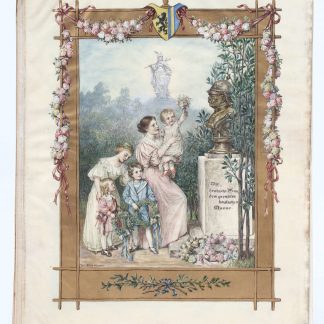
"Die Frauen Leipzigs" - "Die deutschen Frauen dem grössten deutschen Manne". …Leipzig, 1895.
€ 3.500,00 -
![Epsalia [Coptic Hymnal].](https://inlibris.com/wp-content/uploads/2025/01/img-bn64326-324x324.jpg)
Epsalia [Coptic Hymnal].Egypt, 1883 CE = 1599 AM.
€ 6.500,00 -

Order and copy of a petition concerning the accidental death of the slave …Oxyrhynchus village of Senepta, 182 AD.
€ 95.000,00 -
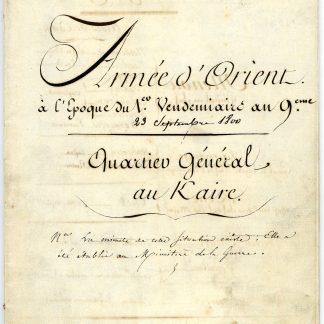
Armée d'Orient à l'époque du 7 Vendémaire an 9eme.Cairo, 23 Sept. 1800 = 1 Vendémaire an 9eme.
€ 35.000,00
