

One of 100 copies: lithographed facsimile of a key manuscript
Vendidad Sadé. L'un des livres de Zoroastre. Lithographié d'après le manuscrit Zend de la Bibliotheque Royale et publié par M. E. Burnouf.
Large folio (44 x 28 cm), 10 issues with salmon-pink wrappers. 562 pp. altogether, lithographed throughout. Uncut in original parts, stored individually in archival portfolios.
€ 45.000,00
One of only 100 copies: a complete lithographed facsimile of the key manuscript which Abraham Anquetil-Duperron had brought to France from India in 1762, winning instant notoriety. This facsimile was issued more than six decades after his feat, over a 14-year period (the lithographer died half-way through the process), under the supervision of the orientalist Eugène Burnouf (1801-52), thus validating both the authenticity of the manuscript and the general accuracy of Anquetil's translation.
A fundamental book for Zoroastrianism, the Vendidad Sadé is a liturgical part of the collection known as the Zend Avesta. It is written in Avestan, the scriptural Old Iranian language which was then considered unreadable; indeed, it was Anquetil who first brought it to wider attention in Europe. His three-volume translation, published in 1771, shocked European scholars by offering "the first known example of a monotheistic text with no direct relation to Judaism, Christianity, or Islam" (Solleveld). His effort was long accused of being a forgery: Anquetil's philological capabilities and personal background appeared questionable, the 1770s already saw fierce debate over Macpherson's Ossian and Chatterton's Rowley poems, and many Enlightenment scholars were taken aback by the apparent absurdity of the liturgical text, which so poorly agreed with their idealized conception of Zoroaster and his religion, associated with simplicity and wisdom.
The controversy raged on for decades until Eugène Burnouf produced his "Commentaire sur le Yaçna" (1833), in which he provided a word-by-word analysis of the Avestan text, collating it with Anquetil’s translation and the Sanskrit translation. The monumental project had to be abandoned after 592 pages of commentary and 192 pages of notes had covered no more than the first 13 pages of Anquetil's manuscript. However, to bolster his case, Burnouf also issued this reproduction of the entire 562-page manuscript, the new process of lithography offering him a method vastly more affordable and quick than engraving. Like his Commentaire, it had only a limited circulation (after all, this was still a text that almost nobody could read), but at least in theory it made Burnouf’s argument accessible to scholarship. Anquetil’s attempt at translation was found to have been premature: "The right approach to the Avesta was through Sanskrit, as E. Burnouf demonstrated sixty years later. But Anquetil was nonetheless the first to bring a manuscript of an ancient oriental sacred text other than the Bible to the attention of European scholars" (Duchesne-Guillemin).
Edges browned; letterpress preliminary matter somewhat stained. Still, a complete, well-preserved and legible edition of one of the fundamental books of Zoroastrianism.
OCLC 1006783544. F. Solleveld, "What Zarathustra said: The sixty-year controversy regarding Anquetil-Duperron’s Zend-Avesta", History and Philosophy of the Language Sciences, 2018 (online). J. Duchesne-Guillemin, Art. "Anquetil-Duperron", in Encyclopaedia Iranica II (2011), pp. 100f.
Ähnlich
-
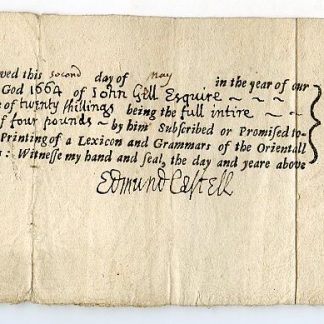
Printed blank form completed in ink and signed by Edmund Castell (Semitic …London, 02.05.1664.
€ 2.500,00 -
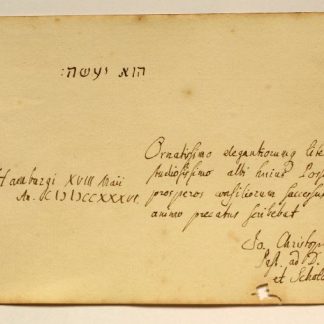
Eigenh. Albumblatt mit U.Hamburg, 18.05.1736.
€ 1.500,00 -

A Grammar of the Common Dialect of the Tamulian Language.Vepery Chennai, 1806.
€ 6.500,00 -
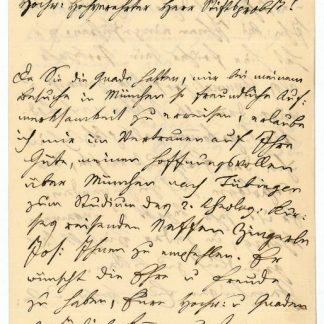
Eigenh. Brief mit U.Meran, 02.11.1855.
€ 150,00
