


The Dutch East India Company in the South China Sea
Manuscript sea chart of the coasts of China, Hong Kong, Taiwan, Vietnam, and the Philippines.
1054 x 800 mm. Manuscript sea chart in India ink and hand-painted colour over engraved Rhumb lines. Framed.
€ 350.000,00
Drawn by hand, and highlighting historical Hong Kong and Guangzhou: the earliest known surviving chart of the region in the hand of Gerrit de Haan, chief mapmaker of the Dutch East India Company. Most likely tailor-made for a Company trading voyage to Canton (today Guangzhou), the map, bearing De Haan's trademark compass rose, would have been copied from the 'legger' or master chart (drawn on vellum), kept in the Batavia (now Jakarta) offices of the Company, to be duplicated as required for outgoing ships.
The chart is noteworthy for its detailed treatment of the approach to Guangzhou from the sea and up the Pearl River, including an early attempt to map Hong Kong, with mixed success. The island of Lantau is erroneously connected to a "Lantau falso", a rare error found on few charts, and Hong Kong itself, along with Lantau, appear to be represented as one large island: a rare miscalculation on the part of Dutch hydrographers. Corrections had to be made on the voyage, too: a handwritten note in Dutch across the shoreline south of the Pearl River reads, "Hier moet de Mandarijn kap zijn ende kust zo veel noordelijker" (roughly translated, "The Mandarin Cape should be here, and the coast further north").
The route upriver from Hong Kong to Guangzhou is given particular attention in the inset at the upper left: a credible town plan of Guangzhou is given, including the internal walls and primary government buildings in the interior, as well as the trading area for foreigners to the south of the river and the two forts on the hill overlooking the city. At the mouth of the Pearl River an anchorage below the fort and battery likely represents the point where foreign vessels were expected to halt before proceeding further.
By the time this chart was drawn, the Dutch East India Company acted as a regional ruling power (Gommans and Van Diessen VII, 33). It had a trading presence and intense interest in the Gulf of Tonkin and the South China Sea, hence the need for a chart of the area. Canton was especially important, being the only port where Europeans could legally access the Chinese market.
All charts by Gerrit de Haan are rare. This chart is known in only one other example, held at the Nationaal Archief in The Hague. However, that chart is later (dated 1760) and not identical: it extends farther to the south and east, and has a different shape for the southern tip of Taiwan and to the Pratas Islands.
Christie's Swire, Hong Kong, 26 Sept. 1989, lot 1070.
In very good condition, with only minor small stains; on blue cloth backing.
Grote atlas van de Verenigde Oost-Indische Compagnie, vols. II and VII. Voorburg, Asia Maior, 2006. Thomas Suarez, Early Mapping of Southeast Asia. Singapore, Periplus, 1999. Insulae Indiae Orientalis. Manila, RLI Gallery Systems Inc., 2018. Armando M. Da Silva, "Fan Lau and its Fort: An Historical Perspective," in Journal of the Hong Kong Branch of the Royal Asiatic Society.
Ähnlich
-
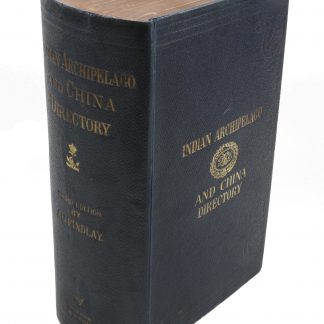
A Directory for the Navigation of the Indian Archipelago and the Coast …London, 1889.
€ 2.500,00 -
![Hedendaegsche historie, of tegenwoordige staet van alle volkeren [...] I. deel. Behelzende [...] China en Japan, als mede van de Ladrones, Filippynsche en Molukkische eilanden, en van Makassar.](https://inlibris.com/wp-content/uploads/2020/05/img-bn48052-324x324.jpg)
Hedendaegsche historie, of tegenwoordige staet van alle volkeren [...] …Amsterdam, 1729.
€ 3.500,00 -
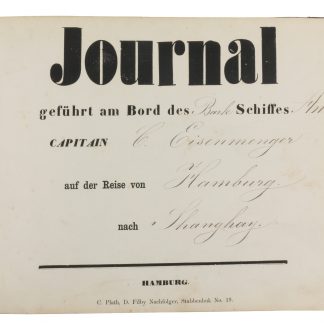
Journal geführt an Bord des Bark Schiffes Anna / Capitain C. Eisenmenger …Formular: Hamburg, 1869-1872.
€ 6.500,00 -
!["A Journal of Remarks and Observations as Kept by E[dward] G[eorge M[orse]. Remarks on board the Sarah Barque of London" [Journal of a Voyage to Seychelles, Madagascar, Mauritius, St Helena and Ascension Island on board the Barque "Sarah" out of London].](https://inlibris.com/wp-content/uploads/2020/04/img-bn32457-324x324.jpg)
"A Journal of Remarks and Observations as Kept by E[dward] G[eorge M[orse]. …Mostly at sea, on board the barque "Sarah" of London, April 1831-14 March 1833 with additions to 1835.
€ 35.000,00
