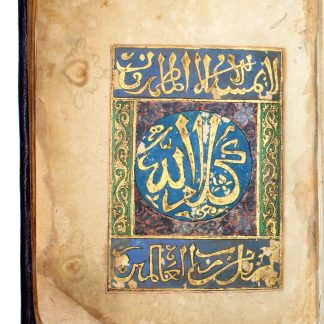


A Chinese Qur'an
An illuminated Qur'an, Juz' XIX.
4to (205 x 263 mm). 56 ff. Arabic manuscript on paper. Black Sini script ruled in red and with red verse markers. Illuminated on first bifolio with elaborate gold gilt border highlighted in red, blue, and green. Contemporary full leather elaborately stamped in blind, with flap.
€ 7.500,00
A complete Chinese manuscript of the 19th Juz' of the Qur'an, decorated with gold. This manuscript is part of the long Islamic manuscript tradition, especially popular among Chinese Muslims, of splitting the Qur'an into thirty sections, called Juz'. Each Juz' would be copied with particularly careful, beautiful Arabic calligraphy in the Chinese Sini script.
The nineteenth Juz' stretches from verse 21 of the 25th Surah, Al-Furqan, and the entirety of Surah Ash Shu'ara', ending with verse 59 of the 27th Surah, An-Naml. These Suwar deal with the punishments inflicted on infidels, the unbelief of the Quraysh, and descriptions of Moses and Solomon.
Arab presence in China dates back as far as the first Caliphate: the Prophet's companion Sa'd ibn Abi Waqqas is traditionally credited with introducing Islam to China as ambassador in 650 CE. Historically, many major cities in China, such as Xi'an (known as Chang'an during the height of the Silk Road) and Beijing, boast a long and rich Muslim history. Qur'an sections written by Chinese Muslims show Chinese influence clearly in both the decoration and the bold Sini script, which is derived from naskh.
Though its colophon is apocryphally dated Safar 940 AH (September 1533) in Yunnan and attributed to a scribe named ibn Fahz al-Din, it is more likely that the manuscript is a slightly later product of the 17th or 18th centuries.
From a private London collection formed in the 1970s and 1980s.
Gentle wear to leather binding; some light soiling, and a few amateur paper repairs to endpapers; altogether well-preserved, with fine calligraphy.