

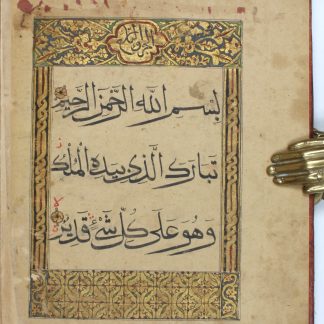
A Chinese Qur'an
An illuminated Qur'an, Juz' XVI.
4to (195 x 265). 57 ff. Arabic manuscript on paper. Black Sini script in five lines double-ruled in red, with red verse markers and Surah titles. Illuminated on first bifolio with elaborate gold gilt border highlighted in red, blue, and green. Contemporary full leather stamped in blind, with flap.
€ 6.500,00
A complete Chinese manuscript of the 16th Juz' of the Qur'an. Its first two pages are decorated with elaborate gold borders, and feature a few words of Arabic glossed phonetically in a later Chinese hand. For example, on the first page, the Arabic "lan" in verse 75 of Surah 18 is glossed with the Chinese character "lan", a word for an orchid. The meaning has no relation, so the gloss is merely present to indicate the sound, which could aid in correctly reciting the Arabic of the Qur'an.
This manuscript is part of the long Islamic manuscript tradition, especially popular among Chinese Muslims, of splitting the Qur'an into thirty sections, called Juz'. Each Juz' would be copied with particularly careful, beautiful Arabic calligraphy in the Chinese Sini script. The sixteenth Juz' stretches from verse 75 of the 18th Surah, al-Kahf, to the end of the 20th surah, Ta Ha. Juz' 16 covers Islamic views on Moses, and tells the story of Dhul-Qarnayn, the mythical traveller who helps to build a wall to keep out Gog and Magog.
Arab presence in China dates back as far as the first Caliphate: the Prophet's companion Sa'd ibn Abi Waqqas is traditionally credited with introducing Islam to China as ambassador in 650 CE. Historically, many major cities in China, such as Xi'an (known as Chang'an during the height of the Silk Road) and Beijing, boast a long and rich Muslim history. Qur'an sections written by Chinese Muslims show Chinese influence clearly in both the decoration and the bold Sini script, which is derived from naskh.
Private London collection formed in the 1970s-1980s,
Some soiling and paper repairs; well preserved.
Ähnlich
-
!["Extraits du Man[uscript] ar[abe] no. 689". Autograph manuscript.](https://inlibris.com/wp-content/uploads/2020/04/img-bn28735-324x324.jpg)
"Extraits du Man[uscript] ar[abe] no. 689". Autograph manuscript.Paris?, c. 1790?.
€ 8.500,00 -
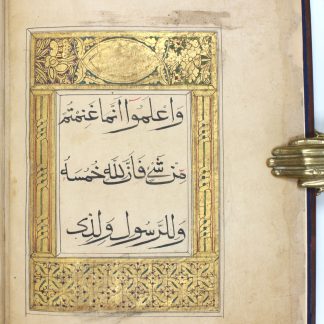
An illuminated Qur'an, Juz' XXIX.China, ca. 1780 - 18th century CE.
€ 8.500,00 -
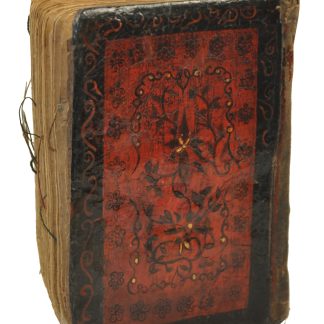
An illuminated Qur'an, Juz' X.China, ca. 1790 - later 18th century CE.
€ 9.500,00 -
Dala'il al-khayrat ("Waymarks of Benefits").Eastern Turkestan, now Xinjiang, China, early 17th century CE.
€ 38.000,00
