![Karandavyuha [Compassionate Acts of Avalokitesvara].](https://inlibris.com/wp-content/uploads/2025/05/img-bn66659.jpg)
![Karandavyuha [Compassionate Acts of Avalokitesvara]. – Bild 2](https://inlibris.com/wp-content/uploads/2025/04/img-bn66659-b.jpg)
![Karandavyuha [Compassionate Acts of Avalokitesvara]. – Bild 3](https://inlibris.com/wp-content/uploads/2025/04/img-bn66659-c.jpg)
![Karandavyuha [Compassionate Acts of Avalokitesvara]. – Bild 4](https://inlibris.com/wp-content/uploads/2025/04/img-bn66659-g.jpg)
![Karandavyuha [Compassionate Acts of Avalokitesvara]. – Bild 5](https://inlibris.com/wp-content/uploads/2025/04/img-bn66659-f.jpg)
![Karandavyuha [Compassionate Acts of Avalokitesvara]. – Bild 6](https://inlibris.com/wp-content/uploads/2025/04/img-bn66659-e.jpg)
![Karandavyuha [Compassionate Acts of Avalokitesvara]. – Bild 7](https://inlibris.com/wp-content/uploads/2025/04/img-bn66659-d.jpg)
![Karandavyuha [Compassionate Acts of Avalokitesvara]. – Bild 8](https://inlibris.com/wp-content/uploads/2025/05/img-bn66659-a.jpg)
Copied by the head monk of "the great Dharmakirti monastery"
Karandavyuha [Compassionate Acts of Avalokitesvara].
Oblong, 420 x 88 mm. 93 ff. Sanskrit manuscript on black-dyed paper. Yellow Ranjana script in five lines, ruled in yellow. Loose, housed in custom clamshell case.
€ 18.000,00
The important sutra of Mahayana Buddhism on the compassion of the bodhisattva Avalokitesvara, copied in Sanskrit by a monk in 17th century Nepal. According to an unusually detailed colophon: "In the year Samvat 765 [1645 CE] [...] in the great Dharmakirti monastery, the Head Monk Sri Purnacandra made for himself, his wife, a veritable goddess of Auspiciousness, Bhikuni, his eldest son Kalyana and his wife Bhafini, and for the middle son Jayakusala and his wife Helamani, and his youngest son Jayadharma and his wife Sumangali, and for his grandson Ratnasri [...] this Mahayana sutra called Karandavyuha, the first Nirvyuha [called] Ratnaraja [...] written while dwelling in the Cakravihara monastery, by Manjudeva son of Elder Manideva, the Vajracarya, the sacrificer priest Kutudeva the Vajracarya [...]".
The Karandavyuha is concerned with the compassionate acts of Avalokitesvara, the most widely revered of the Boddhisattvas. The sutra can be seen as an assimilation of Tantric practices into Mahayana Buddhism, and is the earliest work to deal with the most important Buddhist mantra, "Om mani padme hum". Recitation of this mantra is one of the means by which the devotee can attain rebirth in Sukhavati, the dwelling-place of Amitabha Buddha.
1) Robert McCarthy. 2) Sam Fogg MS.2826, 2007 (published in: Sam Fogg. Paintings on Paper: Nepalese Illustrated Manuscripts. London, 2007).
One leaf chipped; some gentle rubbing. A few passages apparently gone over again with later ink after fading. In good condition.
L. Petech, Mediaeval History of Nepal, Rome 1984 (2nd edition).
Ähnlich
-
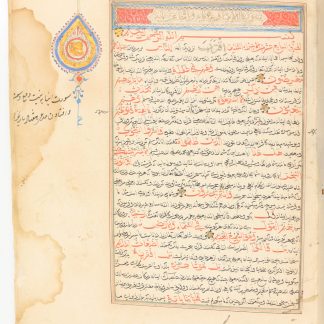
Manuscript Qur'an commentary.Sultanate of Delhi, ca. 1490 CE, or 15th century.
€ 35.000,00 -
![[Manuscript mudras manual].](https://inlibris.com/wp-content/uploads/2024/12/img-bn64231-324x324.jpg)
[Manuscript mudras manual].Nepal, 18th century CE.
€ 35.000,00 -
![Nasen Biku Kyo [Milindapanha - Questions of King Milinda].](https://inlibris.com/wp-content/uploads/2026/04/img-bn68860-324x324.jpg)
Nasen Biku Kyo [Milindapanha - Questions of King Milinda].Japan, 12th century CE, late Heian period.
€ 135.000,00 -

Daihannya haramitta kyo, kan dai-nihyaku-nanajushi (Mahaprajnaparamita …Japan, Tenpyo 13 741.
€ 200.000,00
![Karandavyuha [Compassionate Acts of Avalokitesvara].](https://inlibris.com/wp-content/uploads/2025/05/img-bn66659-324x324.jpg)