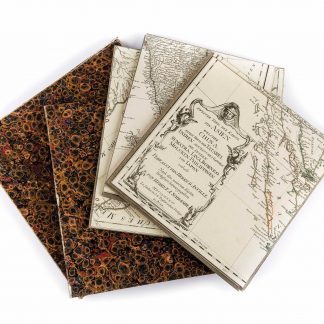


Anciennes relations des Indes et de la Chine, de deux voyageurs mahométans, qui y allèrent dans le neuvième siècle. Traduites d'Arabe. Avec des remarques sur les principaux endroits de ces relations.
8vo (135 x 200 mm). XXXIX, (1), 397, (17) pp. Contemporary full calf with giltstamped spine, leading edges gilt. All edges sprinkled red.
€ 9.500,00
First printed edition in any language: a French translation (from the original Arabic) of one of the earliest surviving accounts of India, Southeast Asia and China, written in 851, with additions perhaps made ca. 916. The famous travel report of the Arab merchant Suleiman al-Tajir, who had visited China and India in the 9th century, is the oldest Arabic account of China, written more than 400 years before Marco Polo. This is augmented by the "Silsilat al-Tawarikh" of Abu Zayd al-Hasan al-Shirafi, written in the early 10th century and based on the account of Ibn Wahb al-Basri, who had visited China shortly after Suleiman.
The texts are translated and edited with a preface and notes by Eusèbe Renaudot. According to Renaudot, the account of events such as the great revolution which swept across China during their second voyage confirms that the journeys were undertaken four centuries prior to Marco Polo. Their travels took place in 851 AD and 877 AD, respectively. The text gives a lively account of life in China and India, with "the first foreign descriptions of tea and porcelain, and a whole panorama of Chinese society, from the Son of Heaven and Confucian ethics down to toilet paper and bamboo urinals" (Mackintosh-Smith). Later Arabic geographers such as Ibn Khordadhbe and al-Mas’udi relied heavily on this work for their information on India and China. "Ces relations sont de la plus haute importance pour la connaissance de l'Inde et de la Chine au moyen-age" (NBG).
The book includes stories about the Indian Ocean and its fish species, the cities around the Arabian Gulf, whales and other large man-eating fish, and the religions of China and India. Other sections discuss commercial routes and the most important products of India, Srinadeb, Java, and China, as well as the presence of Muslims in China in the third and fourth centuries.
Removed from a Paris Jesuit library, as indicated by a contemporary handwritten ownership to title-page ("Domus prof. Paris S. Jesu"); another contemporary ownership deleted from title-page. Later in the collection of the library of the Château d'Oublesse with their ownership stamp to title-page. Red Japanese collection stamp to flyleaf and title-page. As noted on flyleaf, the book was acquired from Librairie Besson in 1955, presumably by F. Binehof, whose bookplate is mounted to pastedown.
Title label lost from spine. Upper cover somewhat wormed; interior dampstained throughout in the upper margin; occasional small marginal tears. Brief handwritten annotation to p. 51, correcting a date.
Lust 298. Cordier Sinica III, 1923-25. Cox I, 335. Sarton I, 571f.
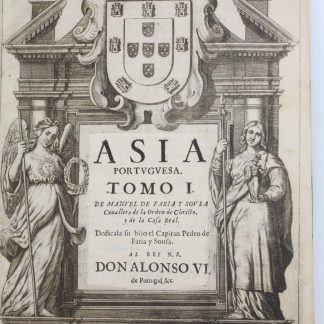
![[Silsilat al-tawarik - English]. Ancient Accounts of India and China, by Two Mohammedan Travellers, Who Went to Those Parts in the 9th Century.](https://inlibris.com/wp-content/uploads/2023/05/img-bn61650-324x324.jpg)
![Memoir on Bahreyn. (And:) Pengelly, W. M. Remarks on a Portion of the Eastern Coast of Arabia between Muscat and Sohar. (In:) The Transactions of the Bombay Geographical Society. From June 1860 to December 1862. [...]. Volume XVI.](https://inlibris.com/wp-content/uploads/2024/04/img-bn63639-324x324.jpg)