


The Macao Peninsula in the second half of the 19th century
A bird's-eye view of Macao.
Painting (350 x 150 cm). Watercolour on paper on contemporary wooden roll.
€ 85.000,00
A massive view of Macao from above, painted in watercolours sometime in the second half of the nineteenth century, during the era in which much of the trade in the area was beginning to shift from the old Portuguese colony to Hong Kong. The peninsula, clearly labelled with the Mandarin toponym Àomén ("Bay Gate"), is very much the focus of the piece: it is depicted effectively as an island, with the Chinese mainland across the isthmus abstracted away into just one of many rocks in the surrounding ocean.
Macao is shown as mountainous and settled mainly on the western and southern shores, with groups of white, blue and yellow buildings. Many are labelled in Chinese, or have yellow banners with Chinese writing on them flying above. Similarly, the rocks in the surrounding waters are dotted with settlements and fortresses labelled in the same way.
The seventeenth-century church of St Paul's stands in ruins at the heart of the settlement, indicating that this piece was painted after 1835, when the building was gutted by a fire, reducing it to its impressive frontage, which remains one of the emblems of Macao to this day. Furthermore, the Portas do Cerco (Border Gate), built in 1849, clearly appears in the northern wall across the isthmus. However, none of the ships depicted are motorised, suggesting that this view was still painted before the founding of the Hongkong, Canton & Macao Steamboat company, when steamships would have become a more common sight.
The centring of Macao in what looks like a vast ocean littered with menacing rocks gives this painting an almost mythological aspect, but the style is clear and realistic, with the landmarks of the colonial settlement clearly depicted. Macao's strategic position on a peninsula connected to the mainland only by a narrow isthmus made it an attractive site for controlling trade in the Pearl River delta and in the region more broadly. Although initially founded as a commercial port by the Chinese in 1535, by 1557, the Portuguese had successfully negotiated a long-term lease of the island from the Ming dynasty and begun to settle there. Macao thus became the first enduring European colonial settlement in China, and moreover was destined to become the last one as well, being handed back to China in 1999.
A beautiful monument to Macao's history in the days of its swansong as a Portuguese trading colony.
From an Italian private collection.
Professionally restored and remargined with a little loss to substance of image, mainly concerning the outer edge and corners, and occasional traces of wrinkles, rubbings or creases. Some waterstaining, mainly to edges. Painting remains clear and vivid.
Ähnlich
-
![Voyages a Peking, Manille et l'Île de France, fait dans l'intervalle des années 1784 à 1801 [...].](https://inlibris.com/wp-content/uploads/2022/07/img-bn45594-324x324.jpg)
Voyages a Peking, Manille et l'Île de France, fait dans l'intervalle des …Paris, 1808.
€ 15.000,00 -
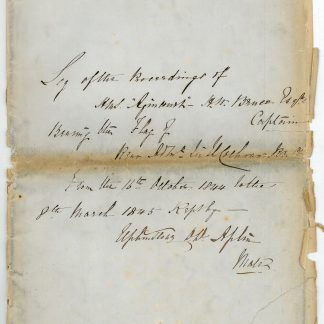
HMS "Agincourt". Manuscript ship's journal.Chusan, Hong Kong, Singapore and other places, 1844-1845.
€ 9.500,00 -
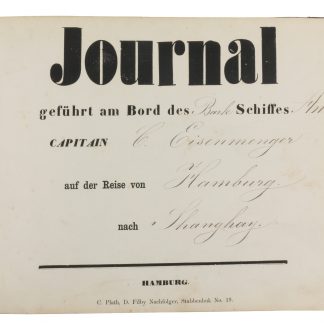
Journal geführt an Bord des Bark Schiffes Anna / Capitain C. Eisenmenger …Formular: Hamburg, 1869-1872.
€ 6.500,00 -
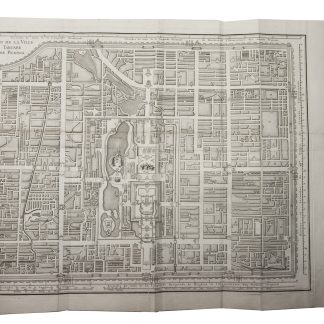
Description de la ville Peking, pour servir à l'intelligence du plan de …Paris, 1765.
€ 18.000,00
