

Keju cheat sheet: a cribbing handkerchief for the imperial examination
Double sided cheat's handkerchief.
Manuscript calligraphy in Chinese characters in black and red ink on silk, 410 x 425 mm (irregular); arranged in vertical columns, surrounded by a narrow border.
€ 9.500,00
This so-called "cheat's handkerchief" was used as an aid by students undertaking civil service examinations under the keju system in imperial China. These examinations, conducted from as early as the seventh century until 1905, were designed to select candidates for admittance into the state bureaucracy. In an effort to promote cultural unity under the empire, the examinations entailed a rigorous assessment of candidates' knowledge of literary and juridical topics such as the Confucian classics, in particular a history known as the Four Books and Five Classics, as well as poetry and policy. By the time of the Ming Dynasty (1368-1644), the highest level of attainment ('jinshi', or 'advanced scholar') had become a prerequisite for a high-ranking position in the imperial government. This system was thus, in theory, a meritocracy. However, as the running of the examinations became progressively bureaucratic and pedantic, candidates increasingly sought alternative methods of success. Given the rigour of these examinations, the surfaces of these aids were covered with as much minute content as possible. Discretion was absolutely paramount, since discovery would have entailed harsh penalties.
The Minneapolis Institute of Arts holds a similar example, also from the Qing dynasty.
A well preserved example, with minor restoration in places.
Ähnlich
-
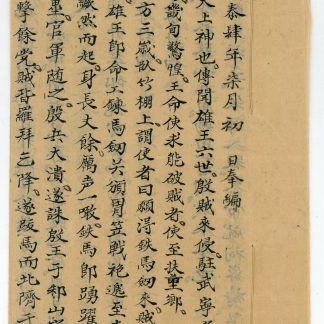
"Histoire sur la vie du grand Génie de Bac Ninh ong Thanh Dong, dit vulgairement …N. p., mid-19th century.
€ 4.500,00 -
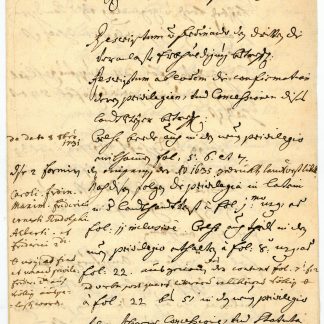
"Extract der in der Landthandvest einkhomenden kays. rescripten und privilegien".O. O., 08.10.1731.
€ 60,00 -
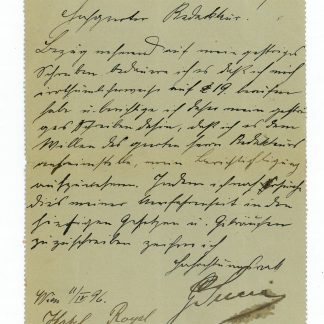
Brief mit eigenh. U. Beiliegend Originalphotographie.Wien, "Hotel Royal", 11.04.1896.
€ 450,00 -
Memoria istorica sopra l'avvenuto in Roma in occasione della Bolla Pretiosus …Rom, um 1727.
€ 650,00
