![Kitab al-Nubuwwat al-Kana’isi ... [The Anagnoseis, or Book of Prophecies].](https://inlibris.com/wp-content/uploads/2026/06/img-bn68306.jpg)
![Kitab al-Nubuwwat al-Kana’isi ... [The Anagnoseis, or Book of Prophecies]. – Bild 2](https://inlibris.com/wp-content/uploads/2026/06/img-bn68306-a.jpg)
![Kitab al-Nubuwwat al-Kana’isi ... [The Anagnoseis, or Book of Prophecies]. – Bild 3](https://inlibris.com/wp-content/uploads/2026/06/img-bn68306-c.jpg)
![Kitab al-Nubuwwat al-Kana’isi ... [The Anagnoseis, or Book of Prophecies]. – Bild 4](https://inlibris.com/wp-content/uploads/2026/06/img-bn68306-d.jpg)
![Kitab al-Nubuwwat al-Kana’isi ... [The Anagnoseis, or Book of Prophecies]. – Bild 5](https://inlibris.com/wp-content/uploads/2026/06/img-bn68306-e.jpg)
![Kitab al-Nubuwwat al-Kana’isi ... [The Anagnoseis, or Book of Prophecies]. – Bild 6](https://inlibris.com/wp-content/uploads/2026/06/img-bn68306-f.jpg)
![Kitab al-Nubuwwat al-Kana’isi ... [The Anagnoseis, or Book of Prophecies]. – Bild 7](https://inlibris.com/wp-content/uploads/2026/06/img-bn68306-g.jpg)
![Kitab al-Nubuwwat al-Kana’isi ... [The Anagnoseis, or Book of Prophecies]. – Bild 8](https://inlibris.com/wp-content/uploads/2026/06/img-bn68306-h.jpg)
Shuwayr Arabic Maronite lectionary with family provenance
Kitab al-Nubuwwat al-Kana’isi ... [The Anagnoseis, or Book of Prophecies].
Folio (228 x 315 mm). 226 pp. Printed in red and black Arabic letterpress throughout. Contemporary blind tooled binding with central Greek cross of arabesque elements within a plant motif frame and internal corner tools.
€ 4.500,00
Second edition of an Eastern Christian liturgical text used by the Maronite Church, first issued in 1775, and a mature product of the celebrated Shuwayr press, comprising portions of the Old Testament and the Apocrypha appointed to be read on Festivals throughout the year, according to the services of the Greek Church.
The typography reflects the established house style of the Shuwayr foundry founded by Abdallah Zakher, whose Arabic punches and matrices sustained Catholic printing in Mount Lebanon and the wider Levant for more than a century. The printing office of the Melkite monastery of St. John the Baptist at al-Shuwayr in the Lebanese Kisrawan mountains was operative between 1734 and 1899, during which time it produced in all 69 Arabic books, including re-editions (cf. Silvestre de Sacy I, pp. 412-414; Middle Eastern Languages and the Print Revolution. A Cross-Cultural Encounter, Westhofen 2002, pp. 179-181).
The volume preserves a coherent series of handwritten Arabic inscriptions documenting its sustained use within a Maronite clerical family. An early note dated 1 November 1835 records the book as assigned to the deacon Musa Shukr Allah, specifying that he was nine years old at the time. Subsequent entries record the births of male children within the same family in 1856, 1858, and 1867, reflecting the customary use of liturgical books as repositories of family record. A later and particularly informative inscription dated 19 February 1880 records the departure of the youngest child, later known as Yusuf Awdi Fadl al Surukan (?), for Beirut, to be placed under the authority of Iqlimisi Yusuf Dahud, the Syriac Catholic archbishop of Mosul, for formal education with the Jesuits, explicitly in preparation for priesthood. Together these inscriptions provide rare, continuous evidence of private Maronite clerical ownership, intergenerational transmission, and direct connection to Beirut-based ecclesiastical education in the late Ottoman period.
As a survival of early 19th-century Christian Arabic printing from Mount Lebanon, the book bears witness to the intellectual and devotional vitality of Near Eastern Catholic communities, now further distinguished by its documented life in use.
Ownership inscription recorded on 1 Nov. 1835 for "Deacon Musa who was nine years old at the time"; family records of the births of three male children in 1856, 1858, and 1867. A later inscription dated 19 Feb. 1880 records the departure of the youngest child to Beirut to pursue priesthood. Two colophons with images, the first of which is printed "ex antiqua gemma hujus magniitudinis" and another icon "finiti le Lettere e i Vangeli".
Well preserved with text block generally clean; scattered light toning and stains. Binding with loss to lower left corner of upper board and other small defects. In good condition.
Nasrallah 43.
Ähnlich
-
![Gêlyânâ dè Yuhannân quddîsâ id est, Apocalypsis Sancti Johannis, ex manuscripto exemplari è bibliotheca ... Josephi Scaligeri ... edita charactere Syro, & Ebraeo, cum versione latina, & notis [...].](https://inlibris.com/wp-content/uploads/2020/05/img-bn44433-324x324.jpg)
Gêlyânâ dè Yuhannân quddîsâ id est, Apocalypsis Sancti Johannis, …Leiden, 1627.
€ 3.950,00 -
![[Kitab ul-muhatibat urtuduksijjah dadd bad il-itiqadat ir-rumijjah]. Dialoghi ortodossi contro alcune credenze greche.](https://inlibris.com/wp-content/uploads/2020/05/img-bn46503-324x324.jpg)
[Kitab ul-muhatibat urtuduksijjah dadd bad il-itiqadat ir-rumijjah]. Dialoghi …Uršulim Jerusalem, 1850.
€ 850,00 -
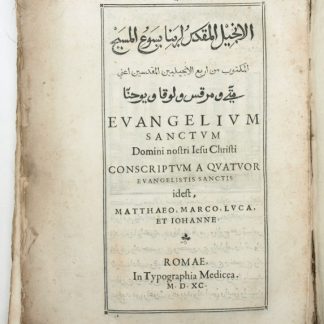
Evangelium Sanctum Domini nostri Iesu Christi conscriptum a quatuor Evangelistis …Rome, 1590-1591.
€ 18.000,00 -
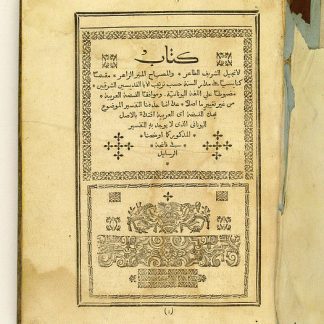
Kitab al-Injil as-sharif at-tahir wa-al-misbah al-munir al-zahir.Dayr al-Shuwayr, Kisrawan, Lebanon, 1776.
€ 8.500,00
![Kitab al-Nubuwwat al-Kana’isi ... [The Anagnoseis, or Book of Prophecies].](https://inlibris.com/wp-content/uploads/2026/06/img-bn68306-324x324.jpg)