

The most notorious atheist text: feared for centuries, banned and burnt
De tribus impostoribus / Traité des trois imposteurs / L'Esprit de Spinoza / etc.
Comprises 3 manuscripts and 10 printed volumes. Mostly 8vo, but also 16mo, 4to, and folio.
€ 95.000,00
An unparalleled collection of manuscript and print copies of the most infamous atheist text in European history, feared by the Church since the Middle Ages and subject to numerous bans and burnings. "On the Three Impostors" argued that Moses, Jesus and Mohammed were all deceivers who had duped humanity into believing in a non-existent God, and that a better life was possible without religion. Including one of only two known manuscripts in existence of the work's English translation, as well as a rare proof of a response to the treatise by Voltaire, these volumes represent an unmatched library of rarities in the history of unbelief.
The notorious text had a long and murky history: in 1239, Pope Gregory IX accused the Holy Roman Emperor Frederick II of having asserted "that the world had been deceived by three impostors, to use his own words: namely Jesus Christ, Moses and Mohammed [...], and that one should believe nothing which could not be proved by the force of reason and nature". However, the book "De tribus impostoribus" ("On the Three Impostors") that Frederick was alleged to have written with the help of his secretary Pietro della Vigna was never found, and could never be proven to exist.
In the following centuries, the work's notoriety grew and grew: the accusation of having written, or even seen, a copy of "The Three Impostors" was a forceful weapon that could be levelled against those with unorthodox views. Ultimately, a text that so many people feared and hated would have to be invented; in the end, more than once.
The French work known as the "Traité des trois imposteurs" came into being in the early eighteenth century. Seemingly the work of a Dutch diplomat named Jan Vroesen (1672-1725), it circulated initially in manuscript form and was first printed in Amsterdam in 1719 under the title "L'Esprit de Spinoza", before being reprinted under the more eye-catching title "Traité des trois imposteurs" in 1721. The work was banned and copies ordered destroyed: only four copies survive of the first printing and none of the second. It criticised not only the philosophical aspects of religion, but the political ones as well: monarchy and religion were fundamentally entwined, it argued, as mutually supportive forms of oppression. Our collection includes two extremely early manuscripts of this text, preceding even the first printing in 1719. Their provenances, in France and Ireland respectively, serve as testimony to the extent of the underground networks through which the text moved over a very short period.
This is also witnessed by the most remarkable volume in the collection: a hitherto unknown manuscript of an English translation of the work, dated to 1739 and discovered 200 years later in a locked drawer in Scotland. The only other known manuscript of "The Three Impostors" in English is in the British Library. Our exemplar is a handsome folio volume written in a fine, elegant hand, larger, earlier and more attractive than the other copy.
After decades when it circulated almost entirely in manuscript form, the text was printed again in 1768 through the efforts of the Enlightenment philosopher and outspoken atheist, the Baron d'Holbach. Subsequent reprintings throughout the 1770s helped fire anti-religious sentiment in a France on the verge of upheaval. Even these later printings were all fairly limited in number, none exceeding 1,000 copies. Our collection includes one 1768 printing and three from the years 1775-77, as well as a remarkable 1796 copy that was modified to celebrate the anti-religious aspects of the French Revolution and a fictitious connection to George Washington and the American Congress.
In addition to the French "Traité des trois imposteurs", a Latin manuscript entitled “De tribus impostoribus” surfaced in Kiel in 1688 and came into the possession of the Austrian general and statesman, Prince Eugene of Savoy. This version of the text was shorter and politically less radical, and was printed in Vienna in 1753. Our collection includes an exemplar of this text from an infamous 1792 printing that was banned and ordered burnt, as well as a clandestine German translation from c. 1787. These bear witness to the work's circulation in the German-speaking world, as does a copy of the first book-length rebuttal of the treatise, the Lutheran Pastor Johann Michael Mehlig's "Das erste schlimmste Buch" from 1764.
The notoriety of the work through the ages also made its title an eye-catching feature for other works: the English scholar and diarist John Evelyn used the title "History of the Three Late Famous Impostors" for a work of 1669, also included in our collection. This discussed three contemporary royal and religious pretenders, including a self-proclaimed Messiah, Sabbatai Zevi, who promised the return of the Jews to Palestine before being taken prisoner by the Ottoman authorities and converting to Islam.
However, the most famous response to the "Three Impostors" came from none other than Voltaire, who wrote a poem attacking it. It was in this connection that the great philosophe first uttered his famous adage, "Si Dieu n'existait pas, il faudrait l'inventer" ("if God did not exist, it would be necessary to invent him"). Our collection includes a highly rare early proof of this poem, printed in a format that was not intended to be seen except by Voltaire and a few friends.
Altogether, this collection represents an outstanding selection of rarities: Rare Book Hub lists only two other manuscript copies sold since 2003, and no print copies on the market since 2021. The manuscript of the English translation is practically unique: earlier, larger and more elegant than the only other known copy, which has been in the British Library since the beginning of the nineteenth century.
An unparalleled library, in both manuscript and print form, of one of the most notorious and incendiary texts in the history of unbelief. Detailed descriptions of every item are available upon request.
1. La Vie de Spinoza / L'Esprit de Spinoza. N. p., [1712-19]. 8vo (134 x 194 mm). 64, (4), 134, (6) pp. Manuscript in French on paper.
2) Traité des trois imposteurs. N. p., 1716. (Bound with) II: La religion chrétienne analysée. N. p., [ca. 1745-67]. 8vo (129 x 201 mm). 157, (3), 80 pp. II: 8vo (126 x 186 mm). 144 pp. Manuscript in French on paper.
3) De Tribus Impostoribus. Or of the Three Imposters. N. p., 1739. Folio (202 x 320 mm). (8), 140, (36) pp. Manuscript in English on paper.
4) Traité des trois imposteurs. Yverdon, De Felice, 1768. 8vo (112 x 167 mm). 144 pp.
5) Traité des trois imposteurs. Amsterdam, 1776. 8vo (105 x 165 mm). (1), 138, (2) pp.
6) Traité des trois imposteurs (Satan). N. p., 1777. 8vo (124 x 187 mm). 152 pp.
7) Traité des trois imposteurs. N. p., [1775-77]. 8vo (101 x 159 mm). 135, (3) pp.
8). Spinoza II oder Subiroth Sopim. Rome [recte Berlin], Wittwe Bona Spes [recte Wilhelm Vieweg d. J.], 5770 [1787]. 16mo (104 x 163 mm). XII, 116 pp.
9) Zwey seltene antisupernaturalistische Manuscripte. Berlin [recte Gießen], Johann Christian Konrad Krieger, 1792. 8vo (98 x 130 mm). 94 pp.
10) Traité des Trois Imposteurs, des Religion Dominantes et du Culte. Philadelphia [recte Paris, Claude Francois Xavier Mercier de Compiègne], 1796. 8vo (130 x 210). (3), 77, (2) pp.
11) John Evelyn, The History Of the Three late famous Impostors. London, 1669. 8vo (95 x 160 mm). (14), 126 pp.
12) Johann Michael Mehlig. Das erste schlimmste Buch. Chemnitz, Johann Christoph Stößel, 1764. 8vo. (12), 100 pp.
13) Voltaire. Poésies Badines. Ferney, 1769. 4to (135 x 205 mm). XXVI pp.
Françoise Charles-Daubert, "Les Traités des trois imposteurs" aux XVIIe et XVIIIe siècles", in Canziani, Baldi and Paganini (eds.), Filosofia e religione nella letteratura clandestina: secoli XVII e XVIII (1994), pp. 291-336. Silvia Berti, Françoise Charles-Daubert and R. H. Popkin (eds.), Heterodoxy, Spinozism, and Free Thought in Early-Eighteenth-Century Europe: Studies on the Traité des Trois Imposteurs (1996). Georges Minois, The Atheist's Bible: The Most Dangerous Book That Never Existed, trans. Lys Ann Weiss (2012).
Ähnlich
-
![Minhaj al-'Abidin [Methodology for the Worshippers].](https://inlibris.com/wp-content/uploads/2020/05/img-bn47072-324x324.jpg)
Minhaj al-'Abidin [Methodology for the Worshippers].Probably Persia Qazvin province?, 3 April 1741 CE = 16 Muharram 1154 H.
€ 1.500,00 -
![Colloquiorum, sive dierum canicularium continuatio, seu tomus quartus. [...] Opus nunc primo editum, opera & studio M. G[eorgii] D[raudii].](https://inlibris.com/wp-content/uploads/2020/08/img-bn10544-324x324.jpg)
Colloquiorum, sive dierum canicularium continuatio, seu tomus quartus. …Frankfurt am Main, 1612.
€ 380,00 -
![Der Menschenfreund. Eine Wochenschrift, geschrieben [...] für das Jahr 1775.](https://inlibris.com/wp-content/uploads/2021/02/img-bn18843-324x324.jpg)
Der Menschenfreund. Eine Wochenschrift, geschrieben [...] für das Jahr …O. O., 1775.
€ 1.800,00 -
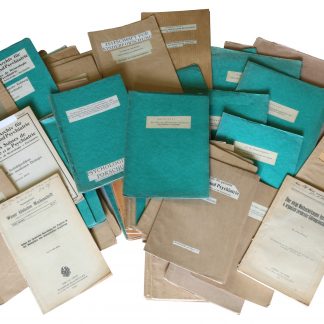
A collection of 82 works from the library of Sigmund Freud.Various places, 1908-1937.
€ 58.000,00
