

Against drunkenness
Fragment of a homily on drunkenness.
Fragment (95 x 95 mm from outermost points). 1 f. Manuscript in Sahidic Coptic on vellum. Set in glass (122 x 162 mm).
€ 18.000,00
A fragment in Sahidic Coptic, in a fine hand of the eighth century. The text, seemingly a homily, admonishes the listeners against drunkenness and its shameful consequences.
Representing a small fragment of a parchment manuscript that may have been damaged or destroyed in a fire, it contains parts of 22 lines of text over two sides. The script is a beautiful, clear uncial with letter-forms that suggest the period between the seventh and ninth centuries, with the most probable date falling around the mid-eighth, although as no Coptic manuscript bears a date before 823, the earlier chronology can be more difficult to establish.
On both sides, the verb "tihe" (to be or become drunk) is clearly visible, as is "shipe" (to be ashamed) on the recto, which helps establish the contents as probably those of a homily against the vices caused by drunkenness. Many prominent early Christian figures who wrote in Coptic discuss alcohol and its attendant evils in their works, notably St Athanasius of Alexandria (d. 373) and St Shenoute of Atripe, Abbot of the White Monastery (d. 466).
Egypt was one of the cradles of early Christianity, producing many saints and theologians who wrote both in Greek and in Coptic, the descendant of the ancient Egyptian language. Possibly in part out of a desire to distance themselves from the pagan past, Christian authors wrote their language in a modified form of the Greek alphabet, rather than Egyptian Demotic script, producing translations of Christian texts from the Greek as well as original works. In addition to Orthodox texts, Gnostic and Manichaean texts were also written in Coptic. Following the Muslim conquest of Egypt in 639-642, Coptic began losing ground to Arabic, but it remained a productive literary language until the eleventh century.
A fine piece of Egypt's millennia-long linguistic and cultural heritage.
1) Bloomsbury Auctions, 2015. 2) Forum Auctions, 2019. 3) French private collection.
Browned overall and singed at lower edge, with small cracks again particularly on lower half. Some staining to surface but text still largely admirably readable. Label affixed to the glass of one side, upside-down.
Anne Boud'hors, "Issues and Methodologies in Coptic Palaeography", in Vanessa Davies and Dmitri Laboury (eds.), The Oxford Handbook of Egyptian Epigraphy and Palaeography (2020), pp. 618-633. Maria Cramer, Koptische Paläographie (1964).
Ähnlich
-

On Christian Behaviour.Fayoum, Egypt, 998/999 CE.
€ 35.000,00 -
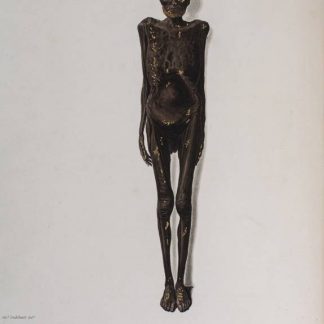
A history of Egyptian mummies, and an account of the worship and embalming …London, 1834.
€ 3.000,00 -
![[Leaf from a MS Coptic Psalter: Psalms 77:25-34].](https://inlibris.com/wp-content/uploads/2024/08/img-bn63924-324x324.jpg)
[Leaf from a MS Coptic Psalter: Psalms 77:25-34].Upper Egypt probably the White Monastery, Sohag, ca. 425 CE / first half of fifth century.
€ 38.000,00 -
![[Fragment of a MS Coptic Psalter: Psalms 19:7-20:3 and 20:6-10].](https://inlibris.com/wp-content/uploads/2024/09/img-bn64191-324x324.jpg)
[Fragment of a MS Coptic Psalter: Psalms 19:7-20:3 and 20:6-10].Upper Egypt probably the White Monastery, Sohag, ca. 425 CE / first half of fifth century.
€ 18.000,00
