Very rare definitive guide to distillation, for the professional and the pauper alike
Liber de arte Distillandi de Compositis. Das buch der waren kunst zu distillieren die Composita und simplicia, und das Buch thesaurus pauperum.
Folio (225 x 322 mm). XVIII [= 20], IX-CCCXLIIII ff. 259 woodcuts and ornamental initials. Rebound in modern half vellum over oak boards by Courtland Benson.
€ 24.000,00
The rare first edition of the author's "Großes Destillierbuch", the definitive work of sixteenth-century distillation and pharmacology, expanded from a briefer version that had appeared in 1500. Printed in German rather than Latin and richly illustrated with elegant woodcuts, this work is distinguished by the inclusion of a "Thesaurus pauperum", a highly useful compendium of affordable remedies. Due to its thoroughness and accessibility, it quickly became a standard reference work, both for professionals as well as everyday people.
Hieronymus Brunschwig drew on centuries of learned tradition as well as a lifetime's experience as a practicing surgeon and apothecary. He divided the work into five books, first laying the theoretical foundation for distillation through a discussion of the "quinta essentia" (the "quintessence" or "fifth element" discussed by Aristotle, a binding agent in the universe) and various preparations, including alchemical recipes such as "drinkable gold" (discussed by Paracelsus among others). The subsequent books discuss drugs composed of one ingredient (simplicia) or more (composita), and enumerate diseases and afflictions of the body they are good for. Finally, the fifth book is the "Thesaurus pauperum", consisting of inexpensive remedies for even the humblest of households.
The over 250 woodcuts depict devices for distillation, as well as apothecaries, doctors and alchemists at work. Intermingled among these are scenes of learning, conversing, and dining, placing medicine within the realm of daily experience.
Hieronymus Brunschwig (c. 1540 - after 1512) was a travelling surgeon, apothecary and alchemist. Born in Strasbourg, he appears to have studied in Paris, Bologna and Padua. He was famed in his day for his revolutionary methods of treating gunshot wounds, probably developed during his experiences in the Burgundian Wars (1474-77).
This copy belonged to Colonel Franz Rudella, whose inscription with the year 1645 is visible on the title-page, a member of a notable Swiss family of Fribourg (Freiburg). His grandfather was probably the Franz Rudella who authored the so-called Rudella Chronicle published in 1568, an important source on the history of his native canton.
A rare and beautiful guide to medicine and distillation, revolutionary for bringing the fruits of science to all levels of society. Also, a considerable rarity: VD 16 lists only eight copies in public institutions, while only three other copies have appeared on the market since 1992, not all of them as in such excellent condition as this example.
1) Col. Franz Rudella (inscription dated 1645 on title-page), probably a grandchild of the Franz Rudella who wrote the so-called Rudella-Chronik of 1568, documenting the history of Fribourg/Freiburg (Switzerland).
2) Arthur & Charlotte Vershbow (acquired from August Laube, 1968).
3) Vershbow sale, Christie’s New York, 9-10 April 2013, lot 139.
4) French private collection.
Lacking the six errata leaves at the end. Some marginalia in a contemporary hand, a few mostly marginal tears or tiny holes, some mild soiling or staining to margins but text overwhelmingly clean and clear. In very good condition.
VD 16, B 8698. Choulant 83. Stillwell, Awakening, 828. Durling 748. Wellcome I, 1114. Rosenthal 3162. Ferchl 73. Kristeller 131. Schmidt, Grüninger, 123. Benzing, Brunschwig, 31 (counting 257 woodcuts). Panzer DA 728. Sudhoff, DMI 59b. Brüning 86. PMM 44. Cf. Partington II, 83. Duveen 107 (third edition only).
Ähnlich
-
![De usu pharmaceutices in consarcinandis medicame[n]tis, Isagoge.](https://inlibris.com/wp-content/uploads/2020/05/img-bn50195-324x324.jpg)
De usu pharmaceutices in consarcinandis medicame[n]tis, Isagoge.Paris, 1543.
€ 7.500,00 -
![In hoc volumine haec continentu.r [!] Ioannis Baptistae Egnatii Veneti in Dioscoridem ab Hermolao Barbaro tralatum annotamenta. Quibus morborum et remediorum vocabula obscuriora in usum etiam mediocriter eruditorum explicantur [...].](https://inlibris.com/wp-content/uploads/2020/05/img-bn50187-324x324.jpg)
In hoc volumine haec continentu.r [!] Ioannis Baptistae Egnatii Veneti …Venice, 1 Feb. 1516.
€ 8.500,00 -
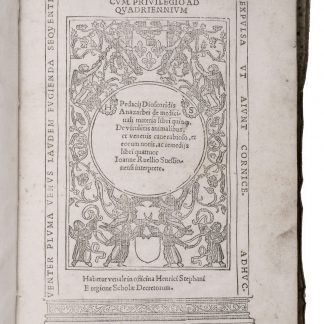
De medicinali materia libri quinque. De virulentis animalibus, et venenis …Paris, 1516.
€ 18.000,00 -
![Philodicus, sive Dialogus de ptisana [suivi de:] Introductionis ad chirurgiam libri duo.](https://inlibris.com/wp-content/uploads/2020/05/img-bn50208-324x324.jpg)
Philodicus, sive Dialogus de ptisana [suivi de:] Introductionis ad chirurgiam …Venice, 1591 all but the preliminaries printed by Francesco Osanna, Mantua, 1584.
€ 12.500,00