

The politics of astronomy during the reign of the Yongzheng Emperor
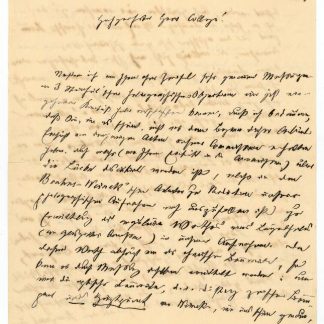
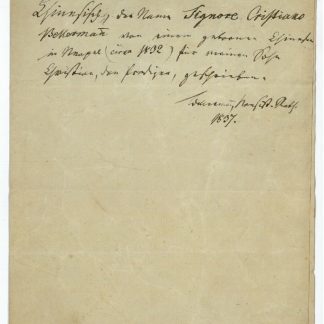
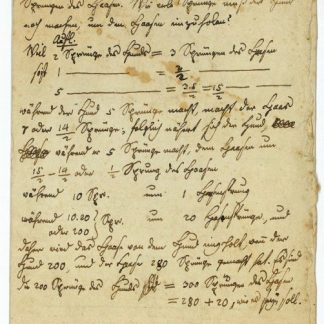
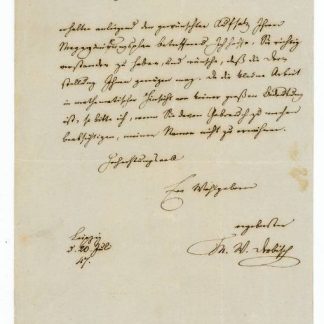
Collection of 26 letters and 29 manuscripts sent from Beijing. Bound together with 1 letter by Ignatius Kögler SJ, 1 letter by Jean-Baptiste Jacques SJ, and 3 manuscripts connected to Kögler, André Pereira SJ, and Karel Slavícek SJ.
Various formats. French and Latin manuscripts on paper and rice paper, on paper guards. With 4 ink-drawn diagrams, 1 map, and 4 autograph duplicates (2 partial). Altogether 186 pp. on 133 ff. Bound in modern quarter morocco, titled in gilt on spine.
€ 85,000.00
Important collection of letters and manuscripts by Antoine Gaubil, bound in one volume, largely in connection with the first publication of Gaubil's astronomical and other scientific works in China as part of the first volume of the "Observations mathématiques, astronomiques, géographiques, chronologiques et physiques". Most letters and manuscripts are addressed to the editor Étienne Souciet SJ (1671-1744), librarian at the Collège Louis-le-Grand in Paris, who added to many documents the date of receipt as well as occasional notes. The three manuscripts of astronomical observations connected to Ignaz Kögler (1680-1746), then director of the Imperial Astronomical Bureau in Beijing, Karel Slavícek (1678-1735), important Czech sinologist and cartographer, and the Portuguese Jesuit André Pereira are also published within the first volume of the "Observations mathématiques".
Beyond Gaubil's contributions to this volume (14 MS, 4 diagrams, 1 map, 2 data sets), three of his manuscripts are connected to the second volume of the "Observations mathématiques" and thus his seminal "Histoire abrégée de l'Astronomie Chinoise" ("Abridged history of Chinese astronomy"): 1) an incomplete manuscript that Souciet quotes and paraphrases extensively for the preface of the "Histoire abrégée"; 2) a table relating to the lunar calendar derived from the Yue Ling-chapter ("Proceedings of government in the different months") within the Liji ("Classic of Rites"); 3) parts of the "Dissértation sur l'Eclipse de Soleil, observée à la Chine l'an 31 de J.C.", wherein Gaubil presents Chinese sources on this eclipse and critically discusses the question of whether this astronomical event could be connected to the "darkness" that, according to the gospels, occurred during the crucifixion of Christ. Finally, the collection includes three long letters from 1727 with the announcement of and highly interesting comments on Gaubil's important "Traité de l'Astronomie Chinoise" that would be published by Souciet in 1732 as the third volume of the "Observations mathématiques".
Apart from offering a rich set of historical astronomical observational data, this collection gives us unique insights into the genesis of Souciet's important publication, the scientific work, interests and convictions of Antoine Gaubil, his wider network, the precarious situation of the mission under the Yongzheng Emperor, the role of science in safeguarding the mission, the relationship of the French mission in China to France, and the inner-Jesuit dispute over the so-called theory of figurism. The observational data is wide in scope, concerning lunar and solar eclipses, the moons of Jupiter, the Pleiades, a comet visible in Beijing in the fall of 1723, an approximation of Venus, Mercury, Earth, and Jupiter. The four beautiful diagrams relate to the passage of the moon through the Pleiades on 19 September 1726, the trajectory of the comet that was also observed in Europe by Edmond Halley, an approximation of the Moon and Mars observed on 19 January 1726, and the approximation of the planets mentioned above. Other manuscripts concern historical astronomical observations in Chinese sources, especially lunar and solar eclipses, and their European equivalents.
Another topic of the published material is Asian geography; including a set of coordinates relative to Tibet and the East Asian river system, a map of the source of the Ganges, both based on works by the important cartographer Jean-Baptiste Régis (ca. 1663-1738), a geographical memoir on the rivers Irtysh and Ob, the partial translation of a report on the diplomatic mission of a Mongol nobleman and courtier in Beijing to the Siberian city of Tobolsk (1712-15), and a description of the Inner Asian Dzunga Khanate under the rule of Tsewang Raptan (1697-1727).
Souciet was the first recipient of most if not all of Gaubil's correspondence, and several letters explain what was to be forwarded to whom, especially to the astronomers Giacomo Filippo Maraldi and Jacques Cassini. Other addressees remain anonymous or unidentified. In a long letter to unnamed Jesuit superiors in France from 20 July 1725, Gaubil laments that all letters sent between August and November 1723 from Europe were lost in Canton. Conversely, the Jesuits in Beijing had to reckon with the fact that many of their shipments would never reach their destination. Apart from the difficulties of communication, Gaubil repeatedly complains about lacking supplies from Europe, ranging from scientific instruments, books, and journals to luxury goods, medicine, and trinkets that were valuable at the Imperial Court during a time of relentless persecution. To him, this frustrating unwillingness or inability to provide material support was threatening the very existence of the French mission: "[…] we are on the eve of seeing our French mission perish. Read what we all write to the Revd. Fr. Orry and De Linyières, pray, grieve, but act for us. What a shame for the Jesuits of France if, after having worked so hard here and in Paris for such a fine establishment, we are forced to abandon it in a way that does us all so much dishonour [...]" (17 November 1726). Beyond the honour of the French Jesuits, Gaubil was probably correct in his conviction that the entire China mission depended on the Jesuits in Beijing and their favour at court as scientists, especially astronomers: "It is a great honour for astronomy that God still wants to use it here to prevent the total ruin of the mission. The emperor has declared in public edicts that he still keeps missionaries in Peking, and Canton for the benefit of those who know astronomical calculation, and I want, he says, my subjects to be instructed in it" (20 July 1725). In a long and insightful undated letter to a French Jesuit named Magnan, Gaubil specifies the necessary qualities of a missionary: "A missionary who comes here must 1st arm himself with a good spirit of mortification, modesty, and firmness, and he must have good health, and angelic patience. By this beginning you can see the violence I must do to myself. 2nd, he must make a very strenuous study of the Chinese language. It is the hardest thing here, and very few missionaries have ever managed to speak Chinese well. That is why in the last 40 years we have only seen 3 or 4 who, in addition to Chinese, were able to learn Tartar. However, this is the language of the court, and although the grandees speak Chinese very well, they are charmed when their Tartar language is spoken to them even badly". With additional talents or knowledge in astronomy, medicine, music, painting, etc. Jesuits can earn favour at court and with the mandarins who regularly come to court from the provinces. Good relations with provincial officials enable the Jesuits at court to recommend and protect the missionaries in the provinces. In this and another letter, Gaubil also mentions that he and his fellow Jesuits were able to baptize thousands of fatally ill or non-viable Chinese newborns, including princes.
Despite the politicization of science as the lifeline of the Jesuit mission to China during the persecutions of the Yongzheng Emperor, the letters impressively show that Antoine Gaubil remained firm in his commitment to scientific method and objectivity. This brought him into conflict with the so-called figurists, in particular Joachim Bouvet (1656-1732) and Jean-Alexis de Gollet (1664-1741), who claimed a common origin of Chinese culture and Christianity and considered the I Ching a prophetic book containing the secrets of Christianity. Although Gaubil was willing to engage with their ideas, he strongly opposed their speculative and far-fetched attempts at harmonizing Chinese and Biblical chronology by instrumentalizing astronomy. In several letters, especially those relative to his "Traité de l'Astronomie Chinoise", Gaubil confronts the theories of figurism. A long letter to Souciet, which he had also sent to Kögler, Slavícek, and Dominique Parrenin, dated 21 November 1728, even provides a direct commentary on a Latin text by Gollet, with the conclusion: "Our business here is to give skilled Europeans an accurate account of what we find here, both for and against, and not to say things with a view to attracting them to our particular opinion, for in that case we expose ourselves to keeping quiet about many important and sometimes decisive things, and to changing the nature of the objects".
Antoine Gaubil, who arrived in Beijing in 1722 and would remain there for the rest of his life, was the most important astronomer among the French Jesuits in China, and one of the greatest disseminators of Chinese science and wisdom in Europe in the 18th century. His work on astronomy and as an historian and translator of important Chinese texts such as the "I Ching" earned him the praise of Alexander von Humboldt as the wisest of the Jesuit missionaries. Joseph Needham even considers him "the interpreter general and father superior of Chinese astronomy".
An inventory and detailed description of the manuscripts and letters in the collection is available on request.
Formerly in the library of Sir Thomas Phillipps (1792-1872). Dispersed over several decades in the 20th century, his manuscript collection is considered the largest ever privately assembled to this day.
Occasional browning, minor stains and tears. One manuscript with deeper tears partly affecting the text. In good condition.
Partly published in: Observations mathématiques, astronomiques, géographiques, chronologiques et physiques...,Tome 1 (Rollin: Paris, 1729) and Observations mathématiques, astronomiques, géographiques, chronologiques et physiques...,Tome 2. Contenant une Histoire de l'Astronomie Chinoise avec des Dissertations (Rollin: Paris, 1732).