![Mokhtassar Sharh Jalinus li-Fusul Abuqrat [Abridgement of Galen’s Commentary on the Aphorisms of Hippocrates].](https://inlibris.com/wp-content/uploads/2025/11/img-bn65459.jpg)
![Mokhtassar Sharh Jalinus li-Fusul Abuqrat [Abridgement of Galen’s Commentary on the Aphorisms of Hippocrates]. - Image 2](https://inlibris.com/wp-content/uploads/2025/11/img-bn65459-c.jpg)
![Mokhtassar Sharh Jalinus li-Fusul Abuqrat [Abridgement of Galen’s Commentary on the Aphorisms of Hippocrates]. - Image 3](https://inlibris.com/wp-content/uploads/2025/11/img-bn65459-b.jpg)
![Mokhtassar Sharh Jalinus li-Fusul Abuqrat [Abridgement of Galen’s Commentary on the Aphorisms of Hippocrates]. - Image 4](https://inlibris.com/wp-content/uploads/2025/11/img-bn65459-a.jpg)
Abridgement of Galen’s celebrated commentary on the Aphorisms of Hippocrates
Mokhtassar Sharh Jalinus li-Fusul Abuqrat [Abridgement of Galen’s Commentary on the Aphorisms of Hippocrates].
8vo (143 × 245 mm). 58 ff. Arabic manuscript on paper. Black naskh script with rubrics in red marking the beginnings of maqalat (treatises) and important terms. Ottoman blind-stamped leather covers in reddish brown, decorated with a central lobed medallion and corner-pieces linked by fillets, framed by a rosette roll-tool border. Rebacked at a later date, with modern spine and replacement endpapers, but preserving the original covers.
€ 18,000.00
A rare witness to the tradition of medical abridgements (mukhtasar), offering a condensed version of Galen’s celebrated commentary on the Aphorisms of Hippocrates. Preserving the first four treatises (maqalat), the text distills the authoritative Arabic transmission produced by Hunayn ibn Ishaq and his circle, omitting extended digressions while retaining the essential doctrines of medical thought.
Alongside reflections on regimen, fullness, purgation, the transformation of humors, and the characteristic vulnerabilities of different ages, the commentary also devotes careful attention to the recognition of critical symptoms and the signs of approaching death (alamat al-mawt). These discussions reveal how ancient physicians were trained to read the body’s signals not only to guide treatment but also to anticipate crisis and mortality with precision. Passages on the corpulence of athletes, the formation of suppuration, or the frailty of maturity illustrate Galen’s constant balancing of natural strength against excess, while titles concerned with the signs of the end of life end remind us of the pragmatic urgency of the Hippocratic-Galenic tradition.
The Aphorisms of Hippocrates (ca. 460-370 BCE), accompanied by Galen’s interpretation (129 - ca. 216 CE), were foundational texts in Greco-Arabic medicine. Their ninth-century transmission into Arabic ensured their central role in Islamic medical education, where they remained indispensable manuals of theory and practice for centuries. The present manuscript, in its epitomised form, vividly illustrates how this tradition was reshaped within the Ottoman period to serve the needs of students and practitioners, preserving the essence of classical medicine in a concise, utilitarian handbook.
The name Mohamad Ahmad appears on the opening folio with the title of the work.
Well preserved with some repairs and markedly stained throughout in the gutter. In good condition.
GAL, S I, 886-887.
Related
-
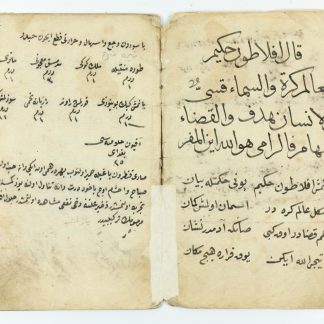
Tazkirah 'ata’ tabib Dari’sh-Shifa’.Eastern provinces of the Ottoman Empire, early 18th century ca. 1720.
€ 3,500.00 -
![Majma' al-manafi' al-badaniyah [Compilation of physical benefits].](https://inlibris.com/wp-content/uploads/2024/02/img-bn62944-324x324.jpg)
Majma' al-manafi' al-badaniyah [Compilation of physical benefits].Ottoman Provinces, 18th century CE.
€ 9,500.00 -
![Kitab yakhtassu bi-l-hikma min qawl al-fudala' [A Book about Medicine (lit. 'Wisdom'), from the Sayings of the Eminent ones].](https://inlibris.com/wp-content/uploads/2024/06/img-bn63820-324x324.jpg)
Kitab yakhtassu bi-l-hikma min qawl al-fudala' [A Book about Medicine (lit. …Ottoman Empire, 18th century CE.
€ 2,800.00 -
![Notizie, ed aventure veridiche di un viaggio intrapreso da una persona di condizione privata [...] di Urbino [...], sino a Costantinopoli; e del ritorno suo [...].](https://inlibris.com/wp-content/uploads/2021/03/img-bn37726-324x324.jpg)
Notizie, ed aventure veridiche di un viaggio intrapreso da una persona …Middle East, 1769-1770.
€ 75,000.00
![Mokhtassar Sharh Jalinus li-Fusul Abuqrat [Abridgement of Galen’s Commentary on the Aphorisms of Hippocrates].](https://inlibris.com/wp-content/uploads/2025/11/img-bn65459-324x324.jpg)