

The French Revolution meets the Islamic World
Proclamation to the People of Egypt.
Folio (220 x 328 mm). Framed and glazed (610 x 495 mm). Arabic manuscript on paper, signed and stamped. 6 pp. on bifolia. Includes custom-made half morocco storage portfolio.
€ 185,000.00
The original Arabic manuscript of the French authorities' proclamation to the people of Egypt, signed by the General-in-chief of the Armée d'Orient, Jacques-François Menou, who following his conversion to Islam took the name Abdallah. Emblazoned with the words "Liberty" and "Equality" in Arabic, this document presents an innovative fusion of French revolutionary rhetoric with Islamic tradition.
In his own hand, Menou adds instructions for the proclamation to be printed in French and Arabic, which it duly was by the Imprimerie Orientale et Française, established shortly before by the French forces as the first printing-press in the Arabic world. This represented a pivotal monent in relations between Europe and the Middle East, both as the first time a modern European power established a military presence in an Arabic country, and through the use of the local language for an edict to the people, rather than simply the language of the colonisers, as would become common later.
The proclamation promises the citizens of Egypt that the French will deliver them from their native elites who had oppressed and exploited them, end the culture of bribery and curb the abuses of translators who tricked people out of their goods, claiming that the French needed them. Menou, "on behalf of the French nation, servants of Allah and His Prophet", assures the people that the French will not steal or endanger their property provided all taxes are duly paid, for "Allah and His Prophet Mohammed ordered that all should be treated fairly".
Menou asks the people of Egypt what good their ruling classes have done them: "The waqfs were meant for building Mosques and providing care for the poor and the hungry, and yet the streets are full of the deprived [...] the very ones who are cheating you, wasting and misusing money from waqfs are the ones people call the most honourable". Menou nonetheless feels the need to underpin his noble promises with a threat: "If you are disloyal to the French Republic and follow the path of the villains who oppose us, our revenge will be swift and terrible".
Napoleon's campaigns in Egypt and Syria were a major turning-point for both Europe and the Middle East, marking the first time in modern history that a Western power had established a military presence in the Arabic-speaking world. Fresh from a series of stunning victories closer to home, Napoleon embarked in 1798 with the long-term goal of disrupting British trade and influence over the route to India. In addition to introducing European-style structures of administration and government, the French military forces were accompanied by a scientific expedition whose investigations led to the foundation of modern Egyptology, including the discovery and decipherment of the Rosetta Stone. It also provided Napoleon with a springboard for ascending to even greater power: just over a year before this document was issued, Napoleon had returned to France, where he seized power in the coup of 18 Brumaire. The command of the Egyptian forces was left to Jean-Baptiste Kléber, who was assassinated in June 1800, after which Menou assumed control, furthermore seeking to buttress his position by marrying into a wealthy Egyptian family and converting to Islam. In the following year, the French were defeated by the combined British and Ottoman forces, and Menou negotiated the terms of the surrender, according to which the British helped his forces return to France in exchange for the antiquities the French scientific expedition had amassed.
A landmark document of Napoleon's Egyptian campaign, testifying to a unique fusion of revolutionary and Islamic rhetoric and a major turning-point in global history.
Some light soiling and handling; folds reinforced.
Related
-
![Die Freien Stunden in Italien in drei Theile bearbeitet und Seiner Hochgebornen dem kai. kön. Herrn Oberst Gustav Graf Degenfeld-Schomburg kai. kön. Käm[m]erer des königlichen Hanoveranischen Guelfen Orden Ritter des Chur Hessischen Löwen Orden Commandeur des Erz-Herzog Leopold 53ten Linien Inft. Regt. Commandant in tiefster Ehrfurcht gewidmet.](https://inlibris.com/wp-content/uploads/2020/04/img-bn21332-324x324.jpg)
Die Freien Stunden in Italien in drei Theile bearbeitet und Seiner Hochgebornen …O. O., 1849.
€ 850.00 -
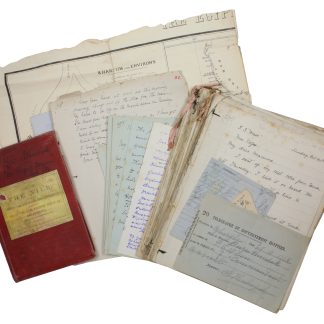
Collection of manuscripts on military expeditions in North Africa and along …Cairo and other places, 1884-1885.
€ 6,500.00 -
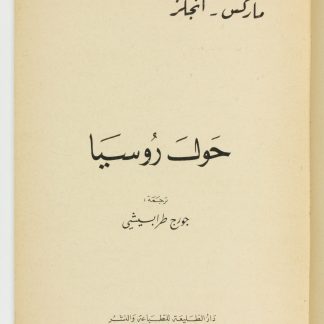
Hawla Rusia (On Russia).Beirut, 1975.
€ 30.00 -
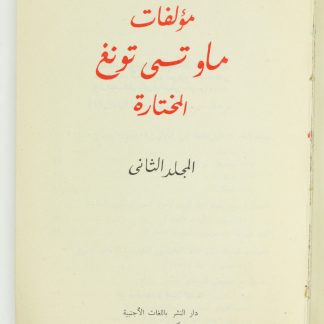
Selected Works of Mao Tse-tung, Volume II (in Arabic).Beijing, 1969.
€ 950.00
