

For promoting the war against the Turks: the only xylographic indulgence form of the fifteenth century
(Indulgence for the war against the Turks). Forma confessionalis et absolutionis ad opus sanctae cruciatae.
Single-sheet broadside, xylographically printed on paper (watermark: a small pair of scales). Type area 130 x 230 mm, sheet 207 x 280 mm. 23 lines. Almond shaped traces of red sealing wax in the lower margin.
€ 65,000.00
Scarce indulgence for the crusading, promulgated by Pope Sixtus IV in 1480 and printed several times, with almost identical wording, in the years 1482 and 1483, mostly on behalf of the individual commissaries. Printed from a single woodblock, this is a block book like, verbatim copy of Friedrich Creussner’s typographic Nuremberg issue (GW 32). It opens with the “Forma confessionalis”, granting the bearer the right to choose a confessor, followed by the “Forma absolutionis”. The blanks (name, diocese, date) remain unfilled. This impression belongs to the second state with the correction in line 4 (“potestatem habeat eligendi”).
The suggestion by Voulliéme, followed by Schreiber, that Johann Schaur, the proto-typographer of Munich, may have been the woodcutter and printer, is circumstantial only. If true, it would make this indulgence likely the earliest surviving printing from Munich. The Bodleian Library now assigns the piece to the Augsburg workshop of Johann Blaubirer on paper evidence, specifically the distinctive ‘scales’ watermark shared with the "Summarium indulgentiarum" (S 237). Long disputed since 1892 (Voulliéme argued for forgery in 1904), the Munich xylographic indulgence was demonstrated to be authentic by Georg Leidinger in 1905 and is accepted as the only xylographically printed indulgence known.
As typical for the group, surviving examples often derive from bindings of the Franciscan convent at Munich, and appear never to have been issued. A singular and early monument of post Gutenberg broadside printing.
1) Deaccessioned by the Royal Library, Munich (later the Bayerische Staatsbibliothek), with pencil note “Duplum Bibliothecae Regiae Monacensis” on verso. 2) William Davignon (1867-1924), Liège; fragment of his bookplate on verso (Egyptian sphinx over “Registrum Mundi 1493”). 3) J. Halle, Catalogue 34, no. 78, with descriptive clipping mounted on verso.
Trimmed close at right edge towards the text; old backing to verso. Minor traces of handling; remnants of sealing wax at foot.
GW 1 Sp. 13a. Cf. GW 32. GW Einblattdrucke 22, 23. Schreiber 2989 (state 2). BSB Ink F 191. Bodleian, XYL 34 (Palmer). ISTC is00568600.
Related
-
![[Articuli abbreviati indulgentiarum Iubilaei et Cruciatae, 11 Dec. 1488]. Diß syndt die artickel deß ablaß am aller kurtzten begriffen yn gantzer krafft und macht.](https://inlibris.com/wp-content/uploads/2024/01/img-bn63205-324x324.jpg)
[Articuli abbreviati indulgentiarum Iubilaei et Cruciatae, 11 Dec. 1488]. …Mainz, ca. 1489.
€ 35,000.00 -
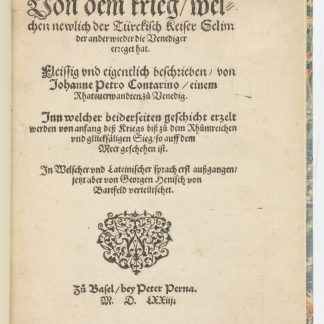
Historia von dem krieg, welchen newlich der Türckisch Keiser Selim der …Basel, 1573.
€ 11,500.00 -
![Sarracenicae historiae libri III. In quibus Sarracenorum, Turcaru[m], Aegypti Sultanorum, [...] origines & incrementa, septingentorumq[ue] annorum res ab illis gestae, brevissimè explicantur.](https://inlibris.com/wp-content/uploads/2020/05/img-bn45058-324x324.jpg)
Sarracenicae historiae libri III. In quibus Sarracenorum, Turcaru[m], Aegypti …Basel, August 1567.
€ 6,500.00 -
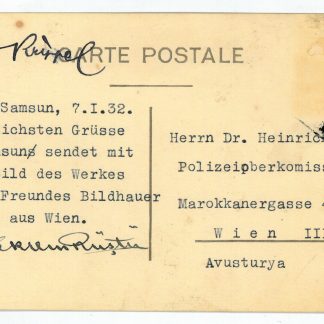
Ms. Postkarte mit eigenh. U.Samsun Türkei, 7 Jan 1932.
€ 160.00
