
![Hasht Behesht [The Eight Heavens].](https://inlibris.com/wp-content/uploads/2026/04/img-bn68621.jpg)
![Hasht Behesht [The Eight Heavens]. - Image 2](https://inlibris.com/wp-content/uploads/2026/04/img-bn68621-a.jpg)
![Hasht Behesht [The Eight Heavens]. - Image 3](https://inlibris.com/wp-content/uploads/2026/04/img-bn68621-c.jpg)
![Hasht Behesht [The Eight Heavens]. - Image 4](https://inlibris.com/wp-content/uploads/2026/04/img-bn68621-d.jpg)
![Hasht Behesht [The Eight Heavens]. - Image 5](https://inlibris.com/wp-content/uploads/2026/04/img-bn68621-e.jpg)
![Hasht Behesht [The Eight Heavens]. - Image 6](https://inlibris.com/wp-content/uploads/2026/04/img-bn68621-f.jpg)
![Hasht Behesht [The Eight Heavens]. - Image 7](https://inlibris.com/wp-content/uploads/2026/04/img-bn68621-g.jpg)
![Hasht Behesht [The Eight Heavens]. - Image 8](https://inlibris.com/wp-content/uploads/2026/04/img-bn68621-h.jpg)
![Hasht Behesht [The Eight Heavens]. - Image 9](https://inlibris.com/wp-content/uploads/2026/04/img-bn68621-i.jpg)
![Hasht Behesht [The Eight Heavens]. - Image 10](https://inlibris.com/wp-content/uploads/2026/04/img-bn68621-j.jpg)
![Hasht Behesht [The Eight Heavens]. - Image 11](https://inlibris.com/wp-content/uploads/2026/04/img-bn68621-b.jpg)
Monumental Mughal illumination with eight narrative paintings
Hasht Behesht [The Eight Heavens].
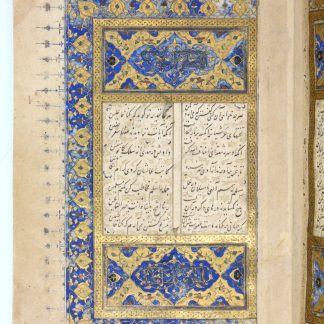
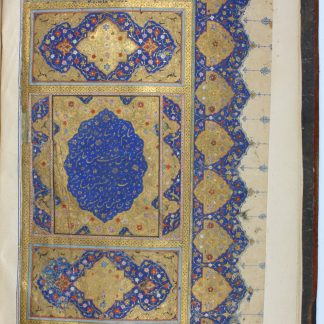
4to (189 x 256 mm). 130 ff. Persian manuscript on polished laid paper. Text written in black ink in a refined and fluent nasta'liq hand. Section headings rubricated in light blue and red. Extensive illumination in gold and colours throughout. Full ruled frames in black, blue, and gold. Eight full-page miniatures in opaque watercolour and gold. Original brown Morocco leather binding, blind-tooled with envelope flap. Stored in a modern satin slipcase.
€ 75,000.00
A complete Mughal court manuscript of Amir Khosrow Dehlavi's "Hasht Behesht", produced to a high workshop standard and preserved in its original binding. The manuscript is fully illustrated and reflects the controlled production of an organised court atelier.
The poem, composed in 1301 CE, represents Amir Khosrow's conscious engagement with the Khamsa tradition established by Nizami Ganjavi (1141-1209 CE). While retaining the narrative core of the Bahram Gur cycle, Hasht Behesht expands Nizami's seven pavilion structure into eight narrative divisions. This structural change allowed for a broader treatment of kingship, desire, ethical judgment, and responsibility, themes that align closely with Mughal court concerns.
The work's illumination programme is extensive and systematic, with sustained use of gold throughout. Illuminated openings alternate between dominant colour families including pinks, greens, reds, and grey blue tones, creating a measured visual progression across the manuscript. The work also contains eight full page paintings, each corresponding to one narrative section. These depict key episodes from the life of King Bahram Gur, including scenes with the seven princesses and the musician Delaram.
The paintings follow established Hasht Behesht iconography, functioning as a continuous narrative sequence rather than as isolated images. The final painting includes an explicit erotic embrace, a feature consistent with both the text and the visual tradition of Mughal courtly copies.
Taking all these elements together, the manuscript presents Hasht Behesht in a complete and coherent form, integrating text, illumination, and painting within a single, stable courtly production.
Two unidentified stamps on the rop corners of folios 1 and 95; a marginal ownership inscription on the last text page recording the year 1115 H (1703/04 CE).
Spine renewed. Occasional light stains and intermittent waterstaining. Exceptionally well preserved.

![Hasht Behesht [The Eight Heavens].](https://inlibris.com/wp-content/uploads/2026/04/img-bn68621-324x324.jpg)