![[Al-jami as-sahih - Sahih al-Bukhari, Vol. I].](https://inlibris.com/wp-content/uploads/2026/03/img-bn68672.jpg)
![[Al-jami as-sahih - Sahih al-Bukhari, Vol. I]. - Image 2](https://inlibris.com/wp-content/uploads/2026/03/img-bn68672-a.jpg)
![[Al-jami as-sahih - Sahih al-Bukhari, Vol. I]. - Image 3](https://inlibris.com/wp-content/uploads/2026/03/img-bn68672-b.jpg)
![[Al-jami as-sahih - Sahih al-Bukhari, Vol. I]. - Image 4](https://inlibris.com/wp-content/uploads/2026/03/img-bn68672-c.jpg)
![[Al-jami as-sahih - Sahih al-Bukhari, Vol. I]. - Image 5](https://inlibris.com/wp-content/uploads/2026/03/img-bn68672-d.jpg)
Moroccan Sahih al-Bukhari with Andalusian audition notes
[Al-jami as-sahih - Sahih al-Bukhari, Vol. I].
Large 4to (210 x 290 mm). 180 ff. Arabic manuscript on polished laid European paper. Black naskh script with headings and keywords in red, blue and occasional green. Text framed within red and blue double rules. Numerous marginal annotations and transmission notes. Red morocco with fore-edge flap, gilt cover fillets and central black leather medallion.
€ 50,000.00
A scholarly Maghrebi copy of the most authoritative Sunni hadith collection. Al-Bukhari’s Sahih, compiled in the third century of Islam, came to function as a foundational instrument of legal argument and public piety. The present first volume preserves the dense paratextual culture of audition, correction, and transmission that sustained its authority.
The text runs from Bad al-Wahy through the chapters of belief and ritual prayer, concluding with al-Istisqa. The present volume is complete within that span. An explicit note at the end states that the following volume begins with the eclipse prayer, confirming that the present codex once formed part of a multi-volume set. The opening folio records the traditional attribution and transmission formula, naming the author in full and tracing the recension through Muhammad ibn Yusuf al-Firabri and the celebrated Abu Dharr Abd ibn Ahmad al-Harawi, whose line became one of the most widely disseminated textual traditions of the Sahih, further mediated by the three renowned pupils associated with Abu Dharr’s teaching.
A lengthy copied certificate preserves a celebrated Andalusian chain of audition and gives it unusual documentary precision: it states that the book was heard by Abu Imran Musa ibn Saadah from Abu al-Walid Sulayman ibn Khalaf al-Baji, and that this was written down by Abu Ali Husayn ibn Muhammad al-Sadafi in Rabi al-Awwal 493 H (Jan./Feb. 1100 CE). The same historical dossier then records a public reading in the congregational mosque of Murcia, completed on a Tuesday with five days remaining of Jumada al-Akhira 507 H (Nov./Dec. 1113 CE), naming as the reader Ismail ibn Ahmad ibn Ismail al-Alshi and noting the attendance of jurists and students. It further records that Abu Abd Allah Muhammad, son of Abu al-Hajjaj Yusuf ibn Saadah, read the whole volume, partly in the congregational mosque and partly in the mosque named after Ibn Abi Hamza Abd al Quddus al Ghafiqi.
In its Moroccan milieu, the Sahih al-Bukhari was not only regarded as a book of scholarship but also as a civic object, recited and deployed in moments of communal intensity. The manuscript's rubrication, coloured markers, and extensive marginalia suggest sustained use for teaching and recitation.
1) Ownership note of Abd al-Nabi ibn al-Majdhub al-Fasi al-Fihri, stating the volume was in his possession and giving the folio count as 180.
2) Ahmad al-Khidr ibn Muhammad al Mufadhaal records the purchase from heirs for 62,000 francs with immediate payment on 17 Rabi al-Anwar 1366 H (8 February 1947).
Spine ends a bit chipped, otherwise tight and well preserved with only light marginal worming.
GAL S I, 261. Muhammadal Mannuni, “Sahih al Bukhari in Moroccan Studies, through its Earliest Transmitters, its Recensions, and its Manuscript Exemplars.” Journal of the Arabic Language Academy in Damascus vol 49, pts. 3 to 4, Damascus,1974.
Related
-
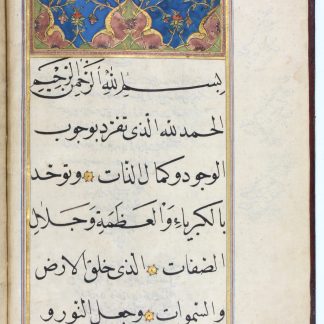
Arabic manuscript on polished paper.Arzu'r-Rum Erzurum, 1650 CE = first days of Muharram 1060 H.
€ 28,000.00 -
![Sharh al-Samarqandi li-l-Risalah al-‘Adudiyah [Samarqandi’s Commentary on al-‘Adudiyah] (and): Hashiyat al-Dusuqi ‘ala Sharh al-Samarqandi li-l-Risalah al-‘Adudiyah [al-Dusuqi’s Supercommentary on Samarqandi’s Commentary on al-‘Adudiyah] (and): Sharh nazm alqab al-Hadith [Commentary on the Didactic Poem of Hadith Classifications].](https://inlibris.com/wp-content/uploads/2024/01/img-bn61084-324x324.jpg)
Sharh al-Samarqandi li-l-Risalah al-‘Adudiyah [Samarqandi’s Commentary …North Africa, 1864-1897 CE = 1281-1314 H.
€ 6,500.00 -

Duaa al-Qamous. Duaa al-Tamta.Persia, 1830/31 CE = 1246 H.
€ 3,500.00 -

A splendid illuminated Qur'an manuscript.Iran, 1783 CE = 1204 H.
€ 18,000.00
![[Al-jami as-sahih - Sahih al-Bukhari, Vol. I].](https://inlibris.com/wp-content/uploads/2026/03/img-bn68672-324x324.jpg)