


A radical abolitionist in the age of Shakespeare: original Quiròs manuscript memorial arguing against the Black slave trade
Manuscript memorial to Philip III of Spain.
Folio (ca. 315 × 220 mm). Spanish manuscript, ink on paper. (22) pp. + 2 lines, blank verso, 2 final blank leaves, the last docketed "Del Capitan Quiros" on verso. Sewn. On laid paper with watermarks throughout (Latin cross within a leaf and figures at the foot, similar to Briquet II, nos. 5683, 5693, 5698, 5700 etc., documented for 16th century Spanish documents).
€ 450,000.00
An exceptional document in the history of Portuguese colonization of South America, and one of the greatest rarities in the field of voyages and exploration: an original manuscript petition, not recorded in any other copy, written to the King of Spain by the Portuguese-Spanish seafarer and discoverer Pedro Fernández de Quirós (Queirós), proposing to settle the "Austral lands" for the Spanish crown. Here, Quirós intercedes with great eloquence on behalf of the suffering Black slaves of Brazil and other South American lands, exploited by the Portuguese and Spanish crowns. At the time of Quirós' writing, African-purchased slaves had been Brazil's largest imported commodity for several decades, their numbers driven ever higher by an increasing international demand for Brazilian sugar that was satisfied by slave labour on the vast sugarcane plantations.
Quirós's famed memorials are foundation documents for the history of the exploration of the Pacific Ocean and Australia, the New World in the South. They conclude the era of great geographical discoveries begun 120 years earlier by Columbus, who had crossed the Atlantic and likewise opened up a new continent. Quirós had led an expedition to the South Pacific in 1606 in search of the hypothetical Terra Australis and had landed on the largest island of what is now Vanuatu, thinking this to be part of the great southern continent and naming it "Australia del Espíritu Santo". Returned to Madrid in 1607, he spent the next seven years in near destitution, lobbying tirelessly for his cause. He composed at least 50 missives to King Philip (largely lost, but of which this is one), arguing the advantages for Spain and the Catholic Church of establishing a colony in the newly-found lands. 14 of these memorials he had printed for presentation at his own expense, and these prints, too, count as extremely rare, having been compared by Carlos Sanz with Columbus's letter announcing his arrival in America. Ultimately, Quirós was entrusted with a new mission to the East, but he died in Panama before reaching Peru. Although Quirós was let down in his grand designs by the Spanish court, who feared that new discoveries would overstretch the already depleted royal coffers, his single-minded perseverance has inextricably linked his name with the history of the discovery of Australia, and indeed, the theory that he had set foot in Queensland was treated as established fact in Catholic Australian education for decades.
The subject of this uncommonly long memorial - a passionate indictment of the black slave trade in the Spanish empire - is highly unusual for the 17th century. Indeed, this treatise includes many arguments that would be adopted by the abolitionists of Enlightenment and must be one of the earliest and most detailed such expositions in Spanish literature: while the slavery of the Amerindian peoples had been condemned by several writers, notably Bartolomé de las Casas, these other authors had no objection to the trade in black slaves.
Quirós's memorial centres around an encounter he purports to have had with a runaway slave called Periquito on the road from Lucca to Pistoia in Italy, thus during his journey to Rome in 1600, though this memorial was undoubtedly written after his 1606 voyage. Periquito gives Quirós an account of his life, from his infancy in Guinea to his enslavement and transportation to Cartagena (now Colombia). Periquito had been enslaved to several people, from wealthy ladies in Lima to a plantation owner in Honduras, to a Spanish merchant with whom he travelled extensively around Central and South America including the various Caribbean Islands. He had practised several trades, including mining for gold and silver, searching for amber in Florida, and diving for pearls on Trinidad. He had set sail for Spain with one of his owners but, after arriving in Seville, had run away to Italy. Periquito describes the harrowing cruelties he suffered at the hands of unscrupulous owners, and expresses great disdain for the slave trade. Quirós elaborates with further examples of the pernicious effects of slavery, setting out various reasons for the slave trade being immoral and the arguments for it hypocritical. He offers personally to lead a punitive expedition against the slave traders, concluding that he would use the rich proceeds from the colonisation of "La Australia", where there would be no slavery, to fund a seminary in Lisbon for the education of African youths who, returned to Africa, would spread civilisation and Catholicism among their own people: "I am a man and they are also men … When our flesh has rotted away, one will see exposed the bones and can determine which of the two skulls is the more beautiful and the whitest … Those who are blind should raise their eyes to the light of reason and see that natural law is in everything equal for everybody … Place me, and others who think like me, in Cartagena de Indias, Puerto Rico, … Brazil, and other regions to which the ships loaded with these people sail. Simply by condemning the masters of these ships to ten years in the galleys … and by giving the black population their freedom, this trade … would, at a stroke, be stopped. For such an enlightened deed, our Spain would merit being crowned with laurels".
While the picaresque encounter with Periquito is either fictional or greatly elaborated by Quirós, it demonstrates the author's remarkable capacity for empathy with his fellow man, and his eloquence calls to mind Shylock's invocation of a shared humanity in Shakespeare's only slightly earlier play "The Merchant of Venice". For this deep understanding of the subject the memorial is appreciated by the Spanish historian Justo Zaragoza, who published the text, in modernized spelling, in his 1880 article "La Esclavitud de los Negros".
Undated, but possibly written before September 1611 (when Quirós, in another memorial, mentions an earlier petition in which he has written "about the black people of the Indies"). Written in a neat scribal hand, with a very few corrections, this would seem to represent a fair copy (none recorded in the National Archives of Spain).
Edges a little frayed in places; occasional light brownstaining and traces of dampness. Traces of old horizontal folds. Altogether very well preserved. A full transcription and English translation are available.
Provenance: described by Zaragoza in 1880 as being the collection of the Madrid bookseller and publisher Santiago Pérez Junquera. Acquired from a UK private collection.
Published in: Justo Zaragoza y Cucala, "La Esclavitud de los Negros", in: La América, ano XXI, nos. 16-22 (28 August 1880 and successive issues). Not listed in Celsus Kelly, Calendar of Documents (Madrid, 1955), Celsus Kelly, La Austrialia del Espíritu Santo, 2 vols. (Cambridge, Hakluyt Society, 1966), or F. M. Dunn, Quirós Memorials (Sydney, 1961), or included in Oscar Pinochet (ed.), P. Fernández de Quirós: Memoriales de las Indias Australes (Madrid: Historia 16, 1991). No copies online, either in the catalogues of State Library of New South Wales, the Real Academia de Historia de España or the Biblioteca Real, or (on PARES) at the Archivo General de Simancas, Archivo General de Indias, or the Archivo Histórico Nacional.
Related
-

Meine Pilgerfahrt nach Jerusalem. (1902.)Probably Vienna, Christmas 1902.
€ 2,500.00 -
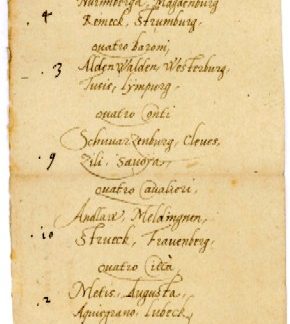
"Li quatro ordeni delle Terre di Germania". Anonymous list of the imperial …N. p. o. d., Italy, ca. 1570-1610.
€ 650.00 -
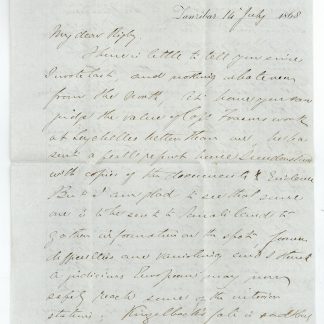
Autograph letter signed ("very sincerely John Kirk").Zanzibar, 14 Jul 1868.
€ 7,500.00 -
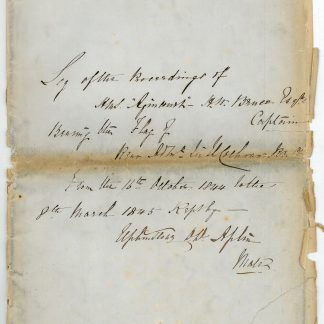
HMS "Agincourt". Manuscript ship's journal.Chusan, Hong Kong, Singapore and other places, 1844-1845.
€ 9,500.00
