

A fourteenth-century synthesis of Hanafi law and scholasticism
Al-Talwih ila Kashf Haqa'iq al-Tanqih.
Large 8vo (183 x 256 mm). 263 ff. Arabic manuscript on paper. Black naskh script, with the opening phrase of sections circled in red, and later marginal annotations in Arabic and Persian. 19th century green leather with red medallions stamped in blind.
€ 28,000.00
A very early manuscript survival: copied only eleven years after the death of the author, known as Sadr al-Shari'a, and comprising a commentary Sadr wrote on his own work on Islamic law. Sadr al-Shari'a the Younger (d. 1346/47 CE), also styled al-Mahbubi, was a leading Hanafi-Maturidi scholar, a jurist, theologian (including a thorough knowledge of hadith), grammarian and astronomer. He is best known for his work on Muslim law in the Hanafi school, and for synthesizing Hanafi ideas with that of medieval scholasticism. In doing so, his work combined the philosophy of Fakhr al-Islam al-Bazdawi with that of famous Maliki jurist and Cairo-based Kurdish grammarian Ibn al-Hajib (d. 1249 CE); these two scholars form the basis of much of his work and interpretations, but his skill in synthesizing different schools of thought is all his own. This very early copy is dated to Dhu'l-Qa'dah, 758 H (October 1357) by its anonymous scribe, little more than a decade after Sadr al-Shari'a was buried in Bukhara, in modern Uzbekistan.
Rebacked, spine replaced. Worming throughout, with some early paper repairs. In two places two leaves in a different hand have been bound in, apparently erroneously, though these contain the same section titles as the main text. They do not, however, replace any original text, which is complete surrounding both additions, with correct catchwords in both cases.
GAL II, 213; S II, 300.
Related
-
![Kanz al-Daqa'iq [The treasures of exactitudes].](https://inlibris.com/wp-content/uploads/2025/07/img-bn65608-324x324.jpg)
Kanz al-Daqa'iq [The treasures of exactitudes].Indian subcontinent, 18th century.
€ 12,500.00 -
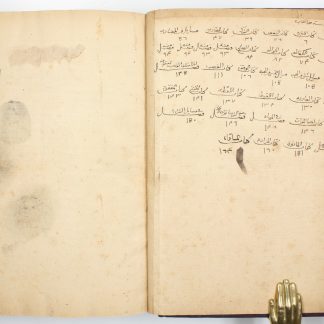
Al-siraj al-wahhaj.Mecca, 1636-1661 CE = 1046-1071 H.
€ 9,500.00 -
![[Naval logbook and diary]. Memorandum book.](https://inlibris.com/wp-content/uploads/2020/05/img-bn47805-324x324.jpg)
[Naval logbook and diary]. Memorandum book.Mainly Eastern Mediterranean, but including South America, the Caribbean, London and other places, chiefly 1835/1836 to 1838, with a few later entries to 1844.
€ 8,500.00 -
![Minhaj al-'Abidin [Methodology for the Worshippers].](https://inlibris.com/wp-content/uploads/2020/05/img-bn47072-324x324.jpg)
Minhaj al-'Abidin [Methodology for the Worshippers].Probably Persia Qazvin province?, 3 April 1741 CE = 16 Muharram 1154 H.
€ 1,500.00
