

"chacun d'eux qui tombe enlève un athlète à lutte de l'avenir"
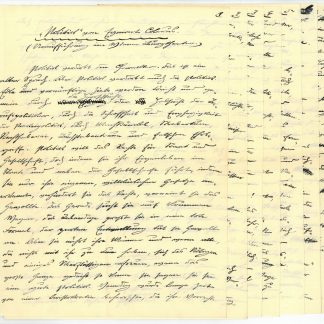
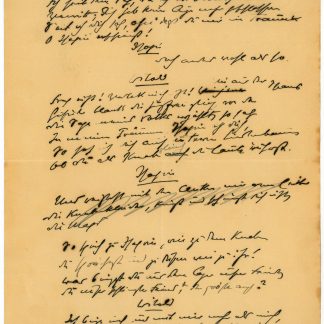
"Les vœux de Lord Palmerston pour l'Italie et la Pologne". Autograph manuscript signed.
4to (218 x 278). 4½ pages on blue stationery.
€ 5,500.00
French manuscript of Dumas's article "I voti di Lord Palmerston", published in Italian in his Neapolitan newspaper, "L'Indépendent", on 8 April 1863. Dumas directly addresses Lord Palmerston, Prime Minister of the UK from 1859 to 1865, criticizing the United Kingdom's lack of support for the Italian and Polish causes and arguing that the existence of small countries should be supported to promote a healthy competition among the peoples.
Dumas attacks Palmerston by comparing the UK and France: unlike Britain, he writes, France (which had begun to back Italy in 1859) was not a country which acted upon its interests, but instead gave in to its passions. While revolutions were not in the French national interest, they benefitted humanity as a whole through achievements such as the constitutional system or universal suffrage, which he calls the last word in popular liberty. Dumas states that it was not England but France that had called for universal suffrage among the army, servants, and Black people: "Est-ce l'angleterre qui à appelle au vote universel, l'armée, les domestiques a la même les nègres - non, c'est la france". He criticises Palmerston's inaction with regard to Poland, wondering whether the UK thought that moral support was enough to rein in Russia: "Lord Palmerston espère que grace à l'appui moral quel angleterre donne a la pologne - les empereurs de Russie serons liberaux et magnanimes envers les polonais". He postulates that ultimately the causes of all countries were the same and that the ruin of any one of them would mean the loss of a champion in the struggle for the future: "[...] leur cause est la même et que chacun d'eux qui tombe enlève un athlète à lutte de l'avenir".
Alexandre Dumas, author of "Le Comte de Monte-Cristo" and "Les Trois Mousquetaires", founded the newspaper "L'Indépendent" in Naples in 1861, having left France ten years prior due to frictions with Louis-Napoléon Bonaparte. Published in Italian, "L'Indépendent" supported the cause of Giuseppe Garibaldi and the Risorgimento. Dumas was convinced that the function of writers in society was through politics, and attempted to enter the political sphere directly through publishing his own newspaper.
First leaf slightly frayed on one edge.