

The true story behind Léon's libretto of "The Land of Smiles"
An autograph letter signed and 2 autograph photo-portraits signed by the Chinese Prince Sukong, who served as the model for the protagonist of the operetta "The Land of Smiles" by Franz Lehár.
Two matted portraits, 255 x 167 and 255 x 170 mm. Letter: 8vo, 4 pages on bifolium. With autograph envelope.
€ 9,500.00
The plot of Franz Lehár's world-famous operetta "The Land of Smiles" is based on a true story from the family of his librettist: an affair between Victor Léon's wife Ottilie ("Otta") and the Chinese prince Sukong. However, the idea for the plot of the operetta came from Léon's daughter Felicitas ("Lizzi"): in a book she had read the phrase, "she loved him because he was different from all the others", and spun out of it a story about a Viennese countess who falls in love with an Indian maharaja. Around the same time, in 1913, a Chinese prince named Sukong was stationed in Vienna as liaison officer and was a frequent guest at the Léon home. He had, apparently with the connivance of Victor Léon, fallen "terribly in love" with Ottilie. The real prince served Léon, who developed his daughter's idea into a libretto, as a reporter on the customs, traditions and ceremonies of Asia; the action was thus transferred from India to China, and the protagonist was named Sou-Chong. This first version, entitled "The Yellow Jacket", premiered in 1923. Reworked with help from the librettists Ludwig Herzer and Fritz Löhner-Beda, it became a worldwide success in the 1928 as "The Land of Smiles".
As testimony to the true story, which ended similarly unhappily, three pieces of correspondence from the prince, whose real name was Shen Chen Ling von Sukong and who spoke German fluently, were preserved by Ottilie Léon. Only one of them - the portrait card dated 14 May 1914 - has so far been published and evaluated by researchers; it is offered here. The lot contains:
1) Portrait of the Prince, by the photo studio Jäger in Krems, with handwritten note above and below the portrait, signed "Sukong, Leutnant d. Republik China", dated Krems, 1 May 1914. The eight-line love poem has been published in full in the autobiography of Franz Marischka, son of Felicitas Léon.
2) Portrait of the Prince, by the studio Jäger in Krems, tenderly inscribed to Otta below the image. Signed "Sukong", dated 1914. Probably written as a farewell in late summer 1914.
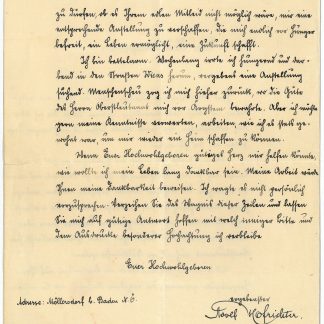
3) Autograph letter signed "Shen Chen Ling", undated (possibly winter/spring of 1915). 4 pages, folded in original envelope. The last text with the most revealing content was written during the voyage on the SS Manchuria on Pacific Mail Steamship Company stationery. It is not dated, but may have been written at the beginning of 1915, since Shen writes that he spent Christmas and New Year's Eve aboard the ship. The ship was sold by the PMSC to the International Mercantile Marine Company in autumn of 1915. The return address reads: "Mr Shen Chen Ling, Shanghai, China, 17 Haskell Road" (probably his accommodation during a short stay on land). As Shen writes, he is now closer to his parents every day, whom he has not seen for seven years. Thus, he must have left China around 1907, being accepted by the Theresian Military Academy ca. 1910, completing his training in October 1913. He then became a lieutenant in the 84th Infantry Regiment "Freiherr von Bolfras" in Krems, before setting out on his home journey at the end of 1914. He writes that now he has "40 days of rail and shipping" behind him; Ottilie can "imagine how terrible this must be for someone who is already a complete Viennese". Finally, the real-life fairy-tale prince reveals himself as a lover of fairy tales himself: "I would be very grateful to you if you would send me beautiful novels and modern operettas, complete with texts, to China".
From the estate of Franz Marischka.
Cf. Barbara Denscher, Der Operettenlibrettist Victor Léon: Eine Werkbiografie (Bielefeld, 2017).