![[Dharani texts].](https://inlibris.com/wp-content/uploads/2025/04/img-bn66450.jpg)
![[Dharani texts]. - Image 2](https://inlibris.com/wp-content/uploads/2025/04/img-bn66450-a.jpg)
![[Dharani texts]. - Image 3](https://inlibris.com/wp-content/uploads/2025/04/img-bn66450-c.jpg)
![[Dharani texts]. - Image 4](https://inlibris.com/wp-content/uploads/2025/04/img-bn66450-d.jpg)
![[Dharani texts]. - Image 5](https://inlibris.com/wp-content/uploads/2025/04/img-bn66450-e.jpg)
![[Dharani texts]. - Image 6](https://inlibris.com/wp-content/uploads/2025/04/img-bn66450-b.jpg)
Printed in blood
[Dharani texts].
540 x 75 mm and two fragmentary pieces, 270 x 75 and 155 x 75 mm, respectively. 6 ff., 6 pp. (2 of 6 leaves are fragmentary). Woodblock printed on paper in red ink. In Tibetan. Previously rolled as scrolls, currently unrolled and stored flat.
€ 4,500.00
A set of Tibetan woodblock-printed dharani texts, purportedly printed in blood. Blood ink has a long tradition in ascetic Buddhism in Tibet, and to the north in China. Two notable examples come from the Dunhuang Cave excavations, and are today held in the British Library. The manuscript Or.8210/S.5451, in Chinese, ends with a scribal colophon which states that the manuscript was written in the scribe's blood. In this case, it can only have been a small amount of blood mixed into what appears to be standard smooth black ink. The second text, Tibetan manuscript IOL Tib J 308, is written in an ink which more closely resembles dried blood (with a reddish-brown pigmentation), and has been shown to have a high iron content. While some inks have naturally high iron, such as black inks, this points to the possibility that this text was indeed written in a high concentration of blood (Schaik).
The present printed manuscript may fall somewhere on this scale, or may simply be printed in a darker than average cinnabar or vermillion ink meant to imitate the blood manuscript tradition. The tradition of blood ink was one of Buddhist extreme ascetism; to write or print a book in blood was an ascetic, spiritual action, and a denial of the flesh. These printed fragments themselves are dharani texts, or descriptions of magical recitations.
1) Acquired in the 1930s by the American astrologer and mystic Manly Hall (1901-90), for the library of the Philosophical Research Society, Los Angeles, dispersed ca. 1996. 2) Sam Fogg MS 19034.
Light edgewear and a few faint stains to top and tail of scrolls; two pieces fragmentary as stated; in good condition.
Sam Fogg MS 19034. Sam van Schaik, "Blood Writing" in the International Dunhuang Program, British Library blog (2012). For ink, cf. British Library IOL Tib J 308.
Related
-
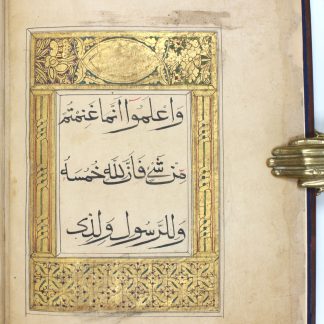
An illuminated Qur'an, Juz' X.China, ca. 1790 - later 18th century CE.
€ 9,500.00 -
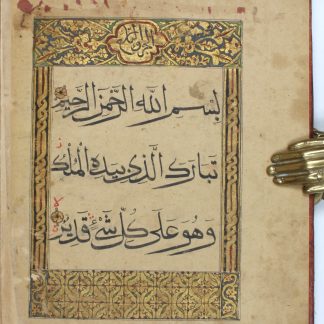
An illuminated Qur'an, Juz' XXIX.China, ca. 1780 - 18th century CE.
€ 8,500.00 -
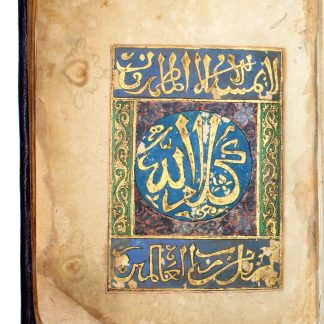
Illuminated Chinese Qur'an.China, ca. 18th century.
€ 250,000.00 -
![Al-salamu ‘alayka [Peace be unto you].](https://inlibris.com/wp-content/uploads/2023/08/img-bn62208-324x324.jpg)
Al-salamu ‘alayka [Peace be unto you].Quanzhou, 1582 CE = 990 H.
€ 35,000.00
![[Dharani texts].](https://inlibris.com/wp-content/uploads/2025/04/img-bn66450-324x324.jpg)