

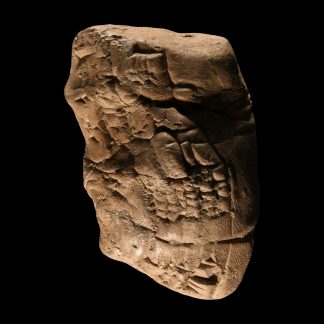
Cuneiform Liver Omens
Cuneiform Liver Omens.
63 mm. Four lines on the obverse.
€ 9,500.00
Extremely rare: Middle Babylonian texts with material relating to the Babylonian science of foretelling the future by studying the entrails of sacrificial animals. These texts were written phonetically in the Old Babylonian period, and in the first millennium were written mostly in logograms. This dates from the beginning of the process of using logograms and is therefore very difficult to translate.
Like a number of other tablets, this one gives only the "if" clause, not the result. In the two omens presented, each ends with a personal name, which cannot so far be explained: "If the pancreas (?) on the right has a detached 'skull' and on the left is bent forwards, [...] Mr Muhaddum, banker. If the pancreas (?) on the right [...], and on the left is bent forward, [...] Mr Ahu-tabum".
Detailed description and dating by Professor W. G. Lambert of the Birmingham University, UK.
The Babylonians were famous for hepatoscopy. This practice is mentioned in the Book of Ezekiel 21:21: "For the king of Babylon stands at the parting of the way, at the head of the two ways, to use divination; he shakes the arrows, he consults the household idols, he looks at the liver". The Nineveh library texts name more than a dozen liver-related terms. The liver was considered the source of the blood and hence the basis of life itself. From this belief, the Babylonians thought they could discover the will of the gods by examining the livers of carefully selected sheep. A priest known as a barû was specially trained to interpret the "signs" of the liver, and Babylonian scholars assembled a monumental compendium of omens called the Barûtu. The liver was divided into sections, with each section representing a particular deity.
Related
-

Letter addressed to Têtuk from the town of Sart.Northern Afghanistan Bactrian kingdom of southern Transoxiana, near modern Kabul, perhaps the city of 'Rob' in the valley of Khulm in northern Hindukush,, ca. 485 CE.
€ 25,000.00 -
Verzeichniss der Arabischen Handschriften der Königlichen Bibliothek zu …Berlin, 1887-1899.
€ 8,500.00 -
Mesopotamian cuneiform clay tablet.Mesopotamia, early 2nd millennium BCE.
€ 8,500.00 -
!["Extraits du Man[uscript] ar[abe] no. 689". Autograph manuscript.](https://inlibris.com/wp-content/uploads/2020/04/img-bn28735-324x324.jpg)
"Extraits du Man[uscript] ar[abe] no. 689". Autograph manuscript.Paris?, c. 1790?.
€ 8,500.00
