

Qajar amuletic scroll to protect pregnancies
Lithographed apotropaic scroll with illustrations.
Scroll of five joined paper strips, 80 x 1665 mm. Lithographed throughout in Arabic and Persian on wove paper, with figures of Sulayman and Umm al-Sibyan. Brown naskh within double ruled borders, with headings, ornaments, and figural details picked out in red and light brown wash.
A rare Qajar amuletic scroll explicitly directed against Umm al-Sibyan, also known as Umm al-Duwais, the demonic force associated in Islamic popular belief with dangers to pregnancy, childbirth, and young children. The present example is distinguished by the striking figural panel of Sulayman (King Solomon) subduing Umm al-Sibyan, giving visual form to the prophet-king’s authority over harmful spirits.
The text combines Arabic invocations with Persian operative passages in a programme specifically intended to shield pregnant women and unborn children from miscarriage, affliction, and other dangers attributed to the demon. It unites sacred language, practical instruction, and images in a single object conceived for apotropaic use rather than passive display. The scroll further invokes the seal and authority of Sulayman as sovereign over jinn, devils, ghouls, and other malignant beings, mobilizing Solomonic and Qur'anic power against a wide spectrum of invisible threats. This explicit appeal to prophetic dominion gives the piece an especially forceful talismanic character.
Scrolls of this kind belong to a popular talismanic tradition in 19th century Iran, where inexpensive lithographic printing allowed protective texts and images to circulate beyond elite manuscript culture. The present piece preserves that conjunction of piety, magic, and everyday need in a particularly vivid and socially grounded form.
Browning and edge wear, joins visible between the sections; minor abrasions and rubbed areas affecting parts of the text. Otherwise in good condition.
Cf. U. Marzolph, “From Mecca to Mashhad: The Narrative of an Illustrated Shi’i Pilgrimage Scroll from the Qajar Period”, Muqarnas 31 (2014), pp. 207-242. ‘Ali Bolukbashi, “Umm al-Sibyan”, in: Daneshname-ye farhang-e mardom, Vol. I (1391 H / 2012 CE), pp. 614-622.
Related
-
![Recueil de planches, sur les sciences, les arts libéraux, et les arts méchaniques, avec leur explication (...)]. Perruquier / Barbier / Baigneur-Etuviste.](https://inlibris.com/wp-content/uploads/2020/04/img-bn19965-324x324.jpg)
Recueil de planches, sur les sciences, les arts libéraux, et les arts …Paris, 1771.
€ 300.00 -
![[Kitab al-Jawami - French]. Apomazar des significations et evenemens des songes, selon la doctrine des Indiens, Perses et Egyptiens.](https://inlibris.com/wp-content/uploads/2020/05/img-bn44155-324x324.jpg)
[Kitab al-Jawami - French]. Apomazar des significations et evenemens des …Paris, 6 Oct. 1581.
€ 6,500.00 -
![A Series of Lithographic Drawings from Sketches by Robert Clive, comprising the undermentioned subjects, lying principally between the Persian Gulf & the Black Sea [...].](https://inlibris.com/wp-content/uploads/2020/05/img-bn51289-324x324.jpg)
A Series of Lithographic Drawings from Sketches by Robert Clive, comprising …London, 1852.
€ 18,000.00 -
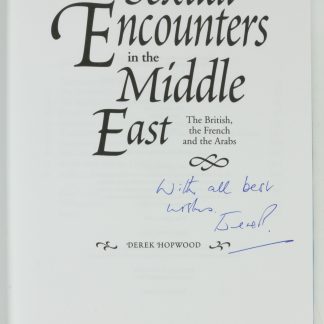
Sexual Encounters in the Middle East: the British, the French and the Arabs.Reading, 1999.
€ 450.00