![[Legendarium].](https://inlibris.com/wp-content/uploads/2025/10/img-bn68230.jpg)
![[Legendarium]. - Image 2](https://inlibris.com/wp-content/uploads/2025/10/img-bn68230-a.jpg)
![[Legendarium]. - Image 3](https://inlibris.com/wp-content/uploads/2025/10/img-bn68230-b.jpg)
![[Legendarium]. - Image 4](https://inlibris.com/wp-content/uploads/2025/10/img-bn68230-c.jpg)
![[Legendarium]. - Image 5](https://inlibris.com/wp-content/uploads/2025/10/img-bn68230-d.jpg)
![[Legendarium]. - Image 6](https://inlibris.com/wp-content/uploads/2025/10/img-bn68230-e.jpg)
![[Legendarium]. - Image 7](https://inlibris.com/wp-content/uploads/2025/10/img-bn68230-f.jpg)
![[Legendarium]. - Image 8](https://inlibris.com/wp-content/uploads/2025/11/img-bn68230-g.jpg)
Gothic Legendary richly rubricated with dozens of fleuronné initials
[Legendarium].
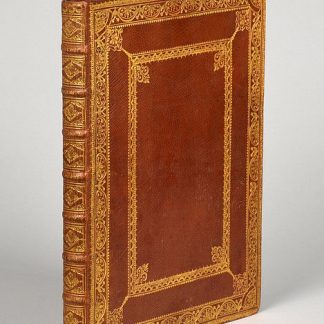
Folio (340 × 250 mm). 274 ff. Latin manuscript on vellum. Arranged in two columns, ca. 46 lines per page in Gothica textualis. Contemporary full red sheepskin over wooden boards with 12 brass bosses and two clasps. Pastedowns originating from a slightly earlier antiphonary with later marginal notes. Stored in custom-made red half morocco box.
€ 95,000.00
Beautifully appointed manuscript hagiography from Benedictine-Cistercian use, featuring lavish rubrication, red lombards, and dozens of red and blue fleuronné initials, prepared by two or three hands in a meticulous textualis script.
Modelled on Jacobus de Voragine’s famous "Legenda aurea", the present manuscript comprises the lives of some 80 saints, arranged by their feasts throughout the liturgical year, carefully listed in an index at the opening of the book, written in red ink throughout. The inclusion of Saints Gangolf and Koloman suggests a Benedictine scriptorium in southeastern Bavaria (Brixen, Freising, Passau, Regensburg, or Salzburg) as the likely place of origin. A final quire, contemporary but in another hand and the same format, adds the life of St Bernard of Clairvaux (fols. 270-273), indicating early assignment to Cistercian use within the Benedictine observance.
The first half (to about fol. 142) is richly decorated with about four dozen large red and blue fleuronné initials, the penwork frequently extending across the full height of the text; several early leaves (3r, 4r, 4v, 5v) show additional pen flourish ornaments in red and black.
Includes 19th century ink foliation on every fifth or tenth leaf, as well as a later erroneous pencil foliation. Concludes with a colophon prayer in red ink: "Qui scripsit scripta, manus eius sit benedicta".
From the collection of the Mainz music publisher Ludwig Strecker (1883-1978). In 1959, 100 items from Strecker's library, including the present manuscript, were exhibited at Gutenberg Museum at Mainz.
A date "1633" is written on the third leaf - perhaps the date of acquisition by an institutional or private collection of the Baroque era.
Quire structure: a2, b–t10, v9 (lacking v7), x–z10, aa–dd10, ee8, ff4; with occasional quire numbers and catchwords.
Binding slightly wormed, rubbed and bumped; leather parts of the clasp straps renewed; joints starting. Some soiling to initial leaves; v7 wanting in the Vita S. Sixti (though probably blank). Occasional contemporary repairs and stitched flaws to vellum. A handsome, broad margined codex preserved in an uncommon original sheepskin binding.
Gutenberg-Museum Mainz, exhibition: "Schöne Bücher aus fünf Jahrhunderten aus einer Privatbibliothek" (1959), No. 2.
Related
-
Officium Beatae Mariae Virg. extra Advent. ad vesp.Innsbruck, c. 1750.
€ 12,000.00 -
Rasmiscgljajte ova dobro. Otza Bartola Baudrand Druscbe Jesussove. Prinesegne …Wohl Balkan, um 1845.
€ 250.00 -
Via viri in adolescentia, seu juventutis in avia deviae.München, 1693.
€ 140.00 -
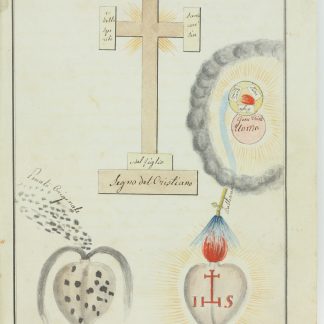
Dottrina Christiana.Genoa, ca. 1815-1820.
€ 18,500.00
![[Legendarium].](https://inlibris.com/wp-content/uploads/2025/10/img-bn68230-324x324.jpg)