To Aloys Hirt on ancient architecture and Ephesus
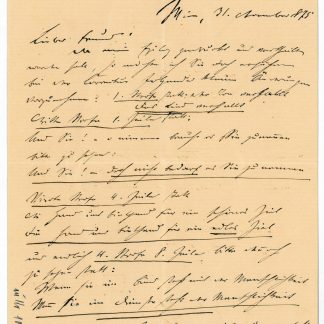
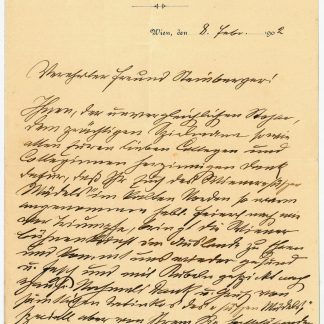
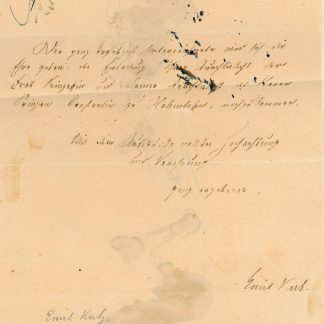
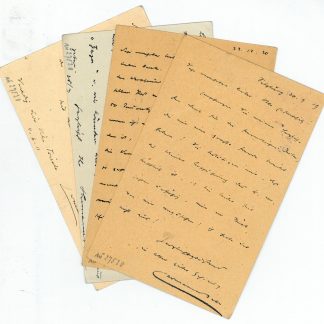
Letter in a secretarial hand (Goethe's secretary Riemer), signed ("Goethe") and with autograph date and place.
4to (220 x 185 mm). 4 pp. On a bifolium.
€ 18,000.00
Extensive and significant letter to the art historian and archaeologist Aloys Ludwig Hirt (1759-1837), prompted by Hirt’s newly issued "Die Baukunst nach den Grundsätzen der Alten" and two shorter treatises.
Goethe explains his desire to lend substance to his responses rather than offer a perfunctory letter of thanks, and praises the two briefer essays (“Der Tempel der Diana zu Ephesus” and “Der Tempel Salomon’s”) for satisfying his "often forcibly returning desire" to rise, at least in spirit, to a vision of the great monuments of antiquity that time has denied to us. He commends Hirt's method: to ground discussion first in trustworthy textual transmission, then admit analogies enlivened by other known data, and finally to bridge remaining gaps with present and related examples - "as conscientious as it is ingenious", convincing and persuasive.
Against earlier antiquarian approaches (he names Caylus), Goethe registers progress and ranges across examples: the Carian Mausoleum, the Alexander Sarcophagus, and the rogus of Hephaestion, for which he hopes a more plausible hypothesis. Reflecting on Greek building practices and the use of terrain, as seen at the theatres of Syracuse and Taormina, he speculates whether the “wall mountains” of a conquered city might have furnished the mass for an immense, easily achieved structure designed to hold a people and an army. He encloses a poem for the painter Friedrich Bury and requests an illustration of the perspective reconstruction of the Ephesian temple; he invites Hirt to visit, noting that he is presently in Jena and has not yet decided about a spa journey.
A rich document of Goethe’s sustained architectural interests and his long friendship with the Berlin antiquary, revealing his critical engagement with methods of archaeological reconstruction at the height of Weimar Classicism.
Meyer & Ernst, Catalogue 31 (Berlin, 1933), no. 134.
Slightly browned.
WA 05744 (Riemer's draft only). Hirt-Goethe correspondence, BBAW, online (corrected draft).