


One of only sixteen surviving copies: the sister volume to what is considered the earliest printed book preserved in America
Daban ruopo luomiduo jing (Maha-prajna-paramita sutra).
Accordion format (295 x 113 mm folded; 8.53 metres extended). Block-printed on paper. Printed paper wrappers with hand-calligraphed title to upper cover. Stored in a blue cloth chitsu folding case with bone fasteners.
€ 165,000.00
Exceptionally early Song-dynasty printing: one volume of the first sutra from the Chinese Buddhist canon, translated from Sanskrit, precisely dated to the fifth lunar month of 1162.
Block-printing had developed in China by the ninth century CE, but almost none of these earliest efforts survive. This early 12th century example predates by five years what was long considered "the earliest printed book preserved in America", namely "a copy of a block-printed book dated 1167, … now in the fine Chinese collection of the Newberry Library, in Chicago” (McMurtrie, p. 91, who does not record this work). Indeed, another separate volume of the present sutra edition survives at Columbia University, which, in the 2006 "Jewels in her Crown" exhibition, selected it as a highlight of their Asian collection: "This extremely rare volume was identified by visiting scholar Shen Jin, from Shanghai Municipal Library, in 1987, as one of only six known surviving volumes of the original 600-volume printing of this Buddhist sutra. Printed apparently privately during the Song Dynasty (960-1279 CE), it is believed to be the oldest book in the Chinese collections at Columbia University. The Prajnaparamita sutra is one of the most important sacred books of Mahayana Buddhism, and Chinese translations of Indian sutras were used in the spread of Buddhism - and of the Chinese written language as well - throughout East Asia" (18).
The whole Buddhist canon (the Tripitaka) was first printed from wood blocks in Ch'eng-tu, China from 972 to 983, but few, if any, examples of that printing survived. Complete, that collection would have "consisted of 5,048 volumes covering 130,000 pages", requiring "the cutting of 130,000 blocks" (Carter, p. 89). While comparison with other surviving volumes of the present edition shows that the work is sometimes described in the colophon as part of a "Dazang jing" (i.e., the Tripitaka), all known surviving fascicles appear to be exclusively from this sutra: possibly, the publisher originally aspired to producing an entire canon, but completed only this sutra, which is the first work in the canon and, spanning 600 chapter-volumes, also quite large. While in 1987 only six of these fascicles were known to have survived, a more recent census locates sixteen, mostly at U.S. research libraries. The present volume contains juan 176 (that at Columbia is 451).
1) Emil Offenbacher, 23 Sept. 1955, sold to:
2) Cornelius J. Hauck, Cincinnati (his sale, Christie’s, 27-28 June 2006).
3) European private collection.
Some worm damage, professionally repaired, otherwise well preserved in the original sutra format with wrappers, housed in a later protective case.
Bun'yu Nanjo, A Catalogue of the Chinese Translation of the Buddhist Tripitaka (London, 1883), no. 1. J. B. Lee (ed.), Jewels in Her Crown: Treasures From the Special Collections of Columbia's Libraries (New York, 2004), no. 18. Cf. Jin Shen, Meiguo Hafo ... [Record of Chinese rare books in the Harvard-Yenching Library in the U.S.] (Shanghai, 1999), p. 476. Douglas C. McMurtrie, The Book: The Story of Printing and Bookmaking (London, 6th printing, 1960). T. F. Carter, The Invention of Printing in China and Its Spread Westward (New York, 2nd ed. 1955). J. Needham & Tsuen-hsuin Tsien, Science and Civilisation in China, Vol. 5: Chemistry and Chemical Technology, Part I: Paper and Printing (CUP, 1985).
Related
-
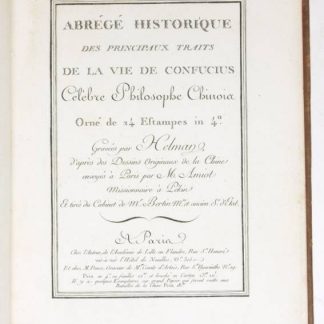
Abrégé historique des principaux traits de la vie de Confucius.Paris, 1788.
€ 3,500.00 -
Daihannya-kyo (Mahaprajnaparamita sutra). Books 1 and 100.Japan, Nara, 1227.
€ 75,000.00 -
Ms. Brief mit eigenh. U.Tokyo, 29 Apr 1977.
€ 950.00 -
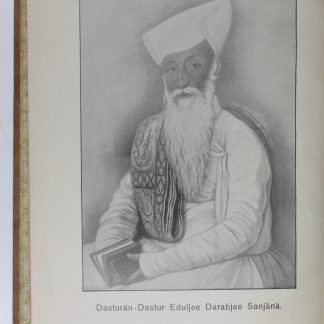
The Dînâ î Maînû î khrat, or, The Religious Decisions of the Spirit …Bombay, 1895.
€ 750.00
