

The first European to enter the Arabian Gulf
Commentarios do Grande Afonso Dalboquerque, Capitao geral que foy das Indias Orientales, em tempo do moito poderoso Rey dom Manuel, o primeiro deste nome. Novemente emendados & acrescentados pelo mesmo auctor.
Folio (180 x 258 mm). Title with woodcut coat of arms, dedication leaf, 578 pp., with some misnumbering (pp. 83-84 as 67-68; pp. 93-94 as 77-78; p. 285 as 297; p. 503 as 471). Woodcut initials, woodcut crucifix on p. 479, and woodcut coat of arms on p. 577. Early speckled calf, spine with raised bands, ruled and tooled in gilt, contrasting morocco title-label.
€ 75,000.00
Second edition, excessively rare and "plus correcte et plus estimée que la première" (Palha). Afonso d' Albuquerque (1453-1515), the Great, was one of the most striking personalities in the history of Portuguese discovery and colonialism and is the founder of the Portuguese Empire in the East Indies. Albuquerque advanced the three-fold Portuguese grand scheme of combatting Islam and securing the trade of spices and the establishment of a vast Portuguese Asian empire. He was the first European to enter the Persian Gulf, led the first voyage by a European fleet into the Red Sea, and was also the first westerner to reach the coast of South-Eastern Arabia: "In 1506 Albuquerque was despatched from Lisbon on an expedition, intended to consolidate Portuguese supremacy in the Indian Ocean. His instructions were to monopolize trade with East India for portugal, and to exclude both Venetians and Saracens from Indian waters [...] Attacks were made on the Arab ports at Malindi, Hoja, Lamu and Brava, before continuing to Socotra [...] Sailing from Socotra with six ships, Albuquerque coasted the Arabian peninsula, sacked Muscat and Sohar, and then launched an attack on Hormuz during the months of September and October 1507. In spite of the overwhelming forces assembled against him by the island's twelve-year-old ruler, Albuquerque mounted a successful siege, with the result that the ruler become a vassal of the Portuguese crown [...] The famous 'Commentaries' [...] were published by his son Alfonso [...], collected from his father's papers. The only documents actually originating from the father are in the form of letters" (Howgego I, 19-21).
Of the utmost rarity: only the 1774 edition is recorded in ABPC. The only copy of the present edition in the trade so far was the one sold by Reiss in 1989 (Auction 40, Travel and Exploration, lot 395).
1) From the collection of Edward Faridany (1939-2010), oil executive, publisher and Persian scholar, with his book label on the front pastedown. 2) Later in a Japanese private collection.
Title leaf and dedication leaf with light waterstain. Some sections browned. A very good copy.
Adams A 568. Wilson 5. Howgego I, 21. Anselmo 222. King Manuel No. 155. BM-Portuguese Books 127. Innocencio I, 7, 36. Barbosa Machado I, 25f. Azevedo-Samodães 60. Salvá 3263. Heredia 3271. Bell, Portuguese Literature, pp. 201f. Palha 4135 f. Cat. Gulbenkian, Portugal & Persia, 126. Henze I, 35ff. Brunet I, 144. Cf. Macro 29 (English 1875 ed. only).
Related
-
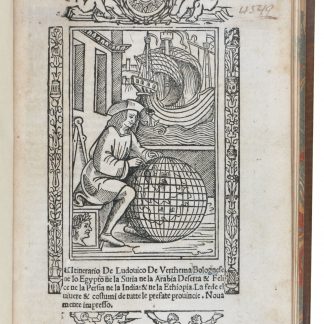
Itinerario de Ludovico de Verthema Bolognese ne lo Egypto ne la Suria ne …Milan, 30 April 1523.
€ 125,000.00 -
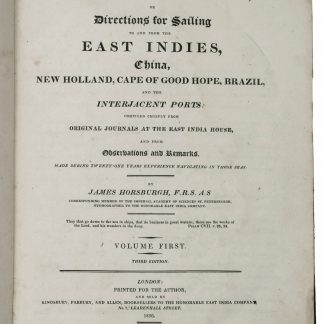
The India Directory, or, directions for sailing to and from the East Indies, …London, 1826-1827.
€ 15,000.00 -
![En tibi lector studiose Strabonis geographicorum co[m]me[n]tarios, olim a Guarino Veronese, & Gregorio Trifernate latinitate donatus, iam vero denuo a Conrado Heresbachio ad fidem graeci exemplaris [...] recognitos.](https://inlibris.com/wp-content/uploads/2020/04/img-bn33844-324x324.jpg)
En tibi lector studiose Strabonis geographicorum co[m]me[n]tarios, olim …Basel, March 1523.
€ 9,500.00 -
![La geografia di Claudio Tolomeo Alessandrino, nuovamente tradotta di Greco in Italiano, da Girolamo Ruscelli, con espositioni del medesimo [...].](https://inlibris.com/wp-content/uploads/2024/04/img-bn52060-324x324.jpg)
La geografia di Claudio Tolomeo Alessandrino, nuovamente tradotta di Greco …Venice, 1561.
€ 25,000.00
