

Indigenous languages of Taiwan
Patar ki tna-msing-an ki Christang, ka tauki-papatar-en-ato tmæu'ug tou sou, ka makka Si-deia. Ofte, 't formulier des Christendoms, met de verklaringen van dien, inde Sideis-Formosaansche tale.
4to. (6), 144, (2) ff. With engraved frontispiece. 18th century full vellum.
Very rare first (and only early) edition of one of the earliest, best and most extensive sources for the East Formosan Siraya language (a member of the Austronesian family native to Taiwan), now largely extinct. It appears here in the form of a bilingual (Siraya and Dutch) catechism, with the Siraya transcribed in the Latin alphabet.
Although the title-page names no author, translator, or compiler, the dedication is signed by the Dutch Reformed missionary Daniel Gravius (van de Graaf, 1616-78), who lived in Formosa from 1647 to 1651. He had published a much shorter Sirayan edition of the Gospel of Matthew in 1661, but the present catechism appears to be the first major published work in the language.
Simon van Breen and Johannes Happart had produced a first draft of the present catechism in manuscript in the 1640s, and Gravius acknowledges their pioneering efforts and those of the Formosan missionary Robert Junius (1606-55), who published a Formosan primer ca. 1647. Gravius's catechism was printed by order of the directors of the VOC and published by Hartogh in Amsterdam. No further edition appeared until Asai published an annotated facsimile in 1939.
The fact that the entire Austronesian family of languages is thought to have originated in Formosa gives additional importance to the study of its early Formosan forms. Gravius's work got Formosan studies off to a good start, but they were to be diverted by the French charlatan George Psalmanazar, who in 1702 adopted a false Formosan identity and in 1704 published an English guide to the supposed Formosan language: in fact, a pure figment of his imagination.
Only five other copies of this edition located, all in European libraries, including the Leiden UL copy, which lacks the integral frontispiece (the STCN description, based on the Leiden copy, mistakenly suggests the missing leaf *1 was blank, but the links to images of a second copy, presumably added later, include the frontispiece).
1) With the signature of the wide-ranging Leipzig classical scholar, librarian and bibliographer Johann Albert Fabricius (1668-1736), who also worked in Hamburg, at the foot of the frontispiece.
2) From the library of the Earls of Macclesfield, with their 1860 "South Library" armorial bookplate and their embossed armorial stamp at the head of the title-page and above the dedication.
3) Sold at Sotheby's, Macclesfield sale, October 2006, Lot 2688.
4) From the library of Swedish antiquarian bookdealer Björn Löwendahl (1941-2013). 5) Sold at Stockholms Auktionsverk, November 2007, Lot 6064.
4to (205 x 160 mm). (6), 144, (2) ff. With integral, engraved frontispiece (showing the title on a cloth surrounded by seven small religious scenes, a cartouche with Hartogh's springing hart device below, flanked by two cartouches, with the seal of the VOC left and the arms of Batavia right), letterpress title-page with a woodcut emblematic device (a rose with 3 bees and a spider), a woodcut factotum and 2 woodcut decorated initials (1 series). 18th century full vellum.
A few small stains to vellum; in excellent condition.
Cordier, Sinica, 292. Landwehr & V. d. Krogt, VOC 682. E. Asai, Gravius's formulary of Christianity in the Siraya language (1939). For general background: Chin Hsin-hui, Colonial "civilizing process" in Dutch Formosa, 1624-1662 (2008). KVK & WorldCat show 5 copies (1 lacking frontispiece); STCN: 2 (the same copies).
Related
-
![Thesaurus Linguae Sanctae [...]: sive concordantiale lexicon hebraeo-latino-biblicum [...].](https://inlibris.com/wp-content/uploads/2020/12/img-bn11002-324x324.jpg)
Thesaurus Linguae Sanctae [...]: sive concordantiale lexicon hebraeo-latino-biblicum …London, 1680.
€ 650.00 -
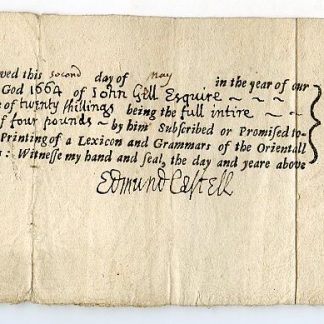
Printed blank form completed in ink and signed by Edmund Castell (Semitic …London, 2 May 1664.
€ 2,500.00 -

Mohammedan "Narratives of the Prophets" Covering the Period from Zachariah …Ürümqi, Xinjiang, 1916-1918.
€ 8,500.00 -
![Al-salamu ‘alayka [Peace be unto you].](https://inlibris.com/wp-content/uploads/2023/08/img-bn62208-324x324.jpg)
Al-salamu ‘alayka [Peace be unto you].Quanzhou, 1582 CE = 990 H.
€ 35,000.00