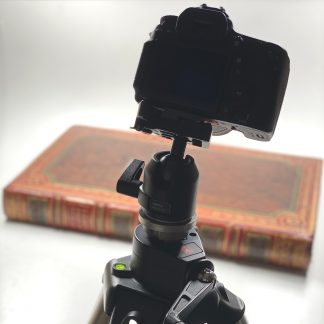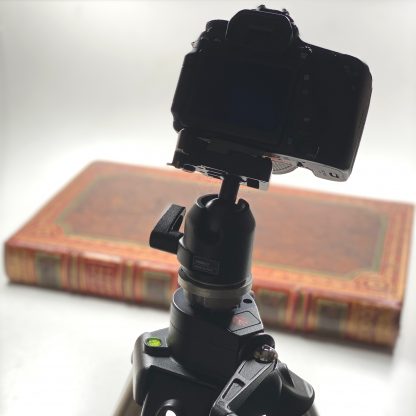
Kitab-i Shahname [The Book of Kings].
4to (145 x 242 mm). 182 ff. Persian manuscript on paper. Nasta'liq script in black ink, with illuminated headings and significant words picked out or underlined in red, and triple rules in red, blue, and gold. With 18 full- to half-page miniatures brightly coloured in blue, pink, orange, black and green. Contemporary stamped full leather binding over wooden boards.
€ 9,500.00
A vividly illustrated Shahnameh section, preserving the opening of Kamus-i Kashani and continuing into Rustam and the Khaqan-i Chin. Several folios preceding the miniatures are further enlivened by oblique inscriptions set in lozenge-shaped cartouches, a feature that strengthens the page design and prepares the transition into the painted scenes.
The eighteen miniatures are executed in bright polychromy with emphatic orange and blue tones, lending scenes of combat, royal encounter, and military consultation a direct theatrical force. The illuminated opening with its gold floral scrolls on lapislazuli ground likewise places the manuscript within the long afterlife of deluxe Persianate book production in the subcontinent.
The Kamus-i Kashani and Khaqan-i Chin episodes belong to the great war cycle that follows the death of Siyavush, when Iranian and Turanian forces draw in auxiliary champions and foreign rulers before Rustam's decisive interventions. In the illustrated tradition of the Shahnameh, Kamus and the Khaqan form a recognisable narrative sequence, repeatedly marked in indexed manuscripts as contiguous episodes.
Completed around 1010 CE after more than three decades of composition, the Shahnameh recounts the legendary and historical past of Iran from the creation of the world to the Arab conquest and rapidly achieved canonical status across Persia, Central Asia, and South Asia. Mughal and other Indo-Persian patrons continued to recopy and reimagine it as a vehicle for dynastic memory, heroic exempla, and pictorial invention.
Binding rubbed with minor tears and soiling to paper. Text occasionally rubbed. Generally in good condition.
Related
-
![Hasht Behesht [The Eight Heavens].](https://inlibris.com/wp-content/uploads/2026/04/img-bn68621-324x324.jpg)
Hasht Behesht [The Eight Heavens].Mughal India, late 16th century.
€ 75,000.00 -
![Farasnama [The Coloured Book of Horses]. Hippiatric manuscript.](https://inlibris.com/wp-content/uploads/2024/04/img-bn59409-324x324.jpg)
Farasnama [The Coloured Book of Horses]. Hippiatric manuscript.India, ca. 1800 CE.
€ 35,000.00 -
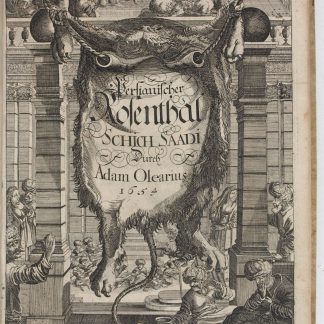
Morgenländische Reyse-Beschreibung.Hamburg & Schleswig, 1658.
€ 25,000.00 -
![Jam'i Jam [The Cup of Jamshid].](https://inlibris.com/wp-content/uploads/2023/09/img-bn62621-324x324.jpg)
Jam'i Jam [The Cup of Jamshid].Timurid Herat, 1459/60 CE = 863 H.
€ 750,000.00