


A book for eternity
Der christlich Glaube Mit Gottseligen christlichen und hoch tröstlichen Gebeten wie ein jeder Christ Täglich vor den Augen des Herrn seines Gottes erscheinen mag.
4to (ca. 212 x 156 mm). German manuscript on vellum. 37 ff.; 1 separate leaf. With 16 mounted full-page engravings, illuminated in gilt and colours, 12 bearing single-line captions in Latin. Modern purple silk binding with floral ornamentation, over wooden boards, on four raised bands. Vellum endpapers. All edges gilt. Stored in felt-lined black half-morocco case with gilt spine title, signed "J. & S. Brockman".
€ 295,000.00
Unique prayer book manuscript on vellum, containing sixteen full-page illuminated engravings after Marten de Vos: a highly expressive devotional work of the waning 16th century. One of only eight known manuscripts by Hieronymus Oertl, it provides a "unique example of the art of book arts around 1600" (Baeyer, p. 6), highlighting the transitory period between the Middle Ages and the Baroque, between manuscript and printed book.
The twelve engravings illustrate the individual articles of the Creed from Creation to the Resurrection and eternal life. Both content and iconography stand out from Oertl's other efforts: only the "frontispiece" was also used in another of his works (albeit with different illumination). The suite is based on a 13-sheet set of engravings after drawings from de Vos's "Credo", printed in Amsterdam in 1633 as "XII Fidei Apostolicae Symbola". The signature "Ioann Collaert sculp." testifies to the engravers Adrian and Jan Collaert II (while the information "M. de Vos invent." and "Adrian Collaert sculp." or "excud." is trimmed away).
The splendid engravings boast gilt highlights and a richly differentiated colour scheme, "ranging from delicate and sensitive translucent washes to pastose coloring" (Baeyer, p. 64). Indeed, Oertl was not only "a fine scribe, but [...] one of the best illuminators of his generation. He was responsible for the selection of the Biblical texts, for writing the prayers, for coloring and gilding the drawings and for illuminating the prints" (ibid., p. 54).
On the title-page, Oertl cut out the central medallion, instead inserting his own title inscription to the vellum below. A cartouche proclaims: "All the dead will be resurrected when God's trumpet will sound", and the conclusion reads: "Whosoever departs from this world will be buried in the heavenly fatherland". Written in uniform Gothic script without initials, Oertl structures the prayer text through the size and colour of the letters, the decoration of the headings, and the use of structuring lines composed of pen and ink filigree. A decorative frame in the form of a narrow, gilt red paper border with black rules encloses text and images. The innovative and elaborate combination of old and new makes this illuminated prayer manuscript a precious possession.
Three unattributable engravings are included before Oertl's suite of illustrations: a genre scene (Elisabeth and St John as a child visit the stable in Bethlehem), the baptism of the Christ, and - as a frontispiece - the triumphant boy Jesus. An unfinished vellum sheet with the mounted engraving of a crucifix by H. Wierix after de Vos appears to be a later addition; however, Oertl himself used this in two other manuscripts.
Tenschert, Kat. 90, Wunderkammer I (2023), Nr. 10. Baeyer, Illuminated Prints 1480-1600 (London, 2019), p. 146. For the etchings after de Vos see Nagler, Künstler-Lexicon XX, 559. For Oertl: Grieb 1097f.; Will III, 71f.
Related
-
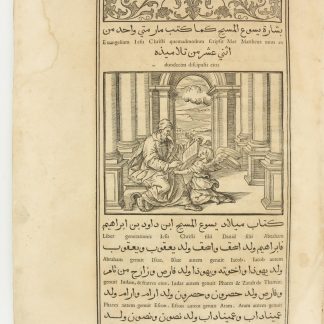
Evangelium Sanctum Domini nostri Jesu Christi conscriptum a quatuor evangelistis …Rome, 1591.
€ 15,000.00 -
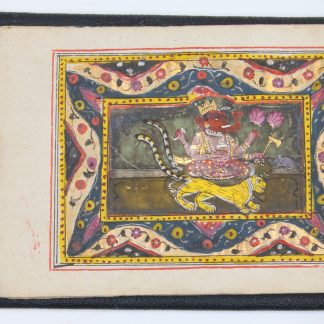
Miniature Bhagavad-Gita manuscript.Probably Kashmir or Punjab / Northern India, ca. 1845 / mid-19th century CE.
€ 18,000.00 -
![Varii fasciculi myrrhae et aromatum, ex passione D[omi]ni collecti.](https://inlibris.com/wp-content/uploads/2022/03/img-bn29070-324x324.jpg)
Varii fasciculi myrrhae et aromatum, ex passione D[omi]ni collecti.Augsburg, 1658.
€ 1,000.00 -
Abbildung der Vornemsten Biblischen Historien Alten Testamentes.Augsburg, 1693.
€ 950.00
