

The most important Engels correspondence in private hands, tracing his formative years
41 letters to Marie Engels and family, with ink and pencil sketches, poems, musical compositions, and a one-act play. Together with a substantial trove of related correspondence.
Correspondence archive comprising 41 autograph letters (with 2 envelopes) and 1 autograph manuscript (a one-act comedy, “Die Verkleidung”) by Friedrich Engels, containing numerous drawings, poems, musical and choral compositions. Further includes 7 letters by Friedrich Engels senior, 2 letters by Rudolf Engels, and one autograph letter each by Emil Blank, F. A. Klingholz, W. Osterroth, and Adolf von Griesheim. Altogether 86 written pages. Various formats. Stored in modern archival portfolios.
By far the most substantial trove of Engels letters ever to have come to market: Engels's complete surviving correspondence with his sister Marie and the Blank family. Dating from his apprentice years in Bremen through his Berlin military service and into the revolutionary decade, the letters are written chiefly to his favourite sister Marie, illuminating the early intellectual and artistic formation of Friedrich Engels.
Beyond the affectionate family news transmitted in the letters, the archive displays an extraordinary creative range: it includes a one-act comedy “Die Verkleidung” (with accompanying costume sketches), caricatures, portraits (with and without cigar), city views, and humorous vignettes; poems including "Bücherweisheit" and another on moustaches; and several musical compositions, among them a choral "Stabat mater dolorosa". The correspondence documents Engels’s youthful polyglot flair (with playful passages in English, Danish, Spanish and Portuguese) and his early literary ambitions.
Politically, the archive records Engels’s first sociological observations from Bremen (while he served as correspondent of the "Telegraph für Deutschland"); later letters from Paris, written in 1848, offer contemporary reflections on class dynamics at the moment of the revolution. Especially notable are the self-portraits and military sketches from Berlin that anticipate the later "General", as well as a comical hoax letter in Spanish in which Engels impersonates his own teacher, testifying to the close rapport between the siblings that animates the entire ensemble.
While most of the letters in the present archive were published in MEGA from photocopies between 1975 and 2000, the originals were inaccessible for at least half a century and thus remained beyond the reach of scholarship; their whereabouts were latterly unknown. Two letters by Friedrich Engels's brother Rudolf (1831-1903) are entirely unpublished, as are seven by his father Friedrich senior (1796-1860), from which only a brief excerpt saw print in 1979, three others by the fellow merchants F. A. Klingholz, Adolf von Griesheim, and W. Osterroth, as well as one by Emil Blank, Marie's husband.
Preserved within the original family by descent, the material offers one of the most intimate surviving narratives of Engels’s development before his collaboration with Karl Marx came to define his public identity.
1) From the recipients Marie Engels (later Marie Blank, 1824-1901) and Karl Emil Blank (1817-93); thence by direct family descent to 2) their daughter Cecilie Vorwerk (née Blank, 1855-1928), 3) Cecilie's daughter (Marie) Mathilde Mittelsten Scheid (née Vorwerk, 1876-1949), 4) Mathilde's husband, the industrialist (Karl) August Mittelsten Scheid (1871-1955), 5) their daughter Alice Emilie Siller (née Mittelsten Scheid, 1902-80) and 6) her daughter Anita Emcke (née Siller, 1929-2006). Sold to 7) Krystyna Gmurzynska in 1989 and subsequently in the collection of Galerie Gmurzynska, Zürich, from whom the material was acquired directly.
Well preserved overall, with expected folds and occasional minor tears or soiling. Itemized condition report available on request.
MEGA III.1 (letters to April 1846), pp. 76-283; III.2 (May 1846 to Dec. 1848), pp. 142-155, 567; III.3 (Jan. 1849 to Dec. 1850), p. 105; III.4 (Jan.-Dec. 1851), p. 271; III.6 (Sept. 1852 to Aug. 1853), p. 91; III.10 (Sept. 1859 to May 1860), p. 448. Full transcriptions of all unpublished material are available.
Related
-
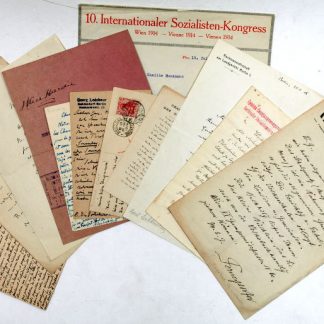
11 autogr. signed letters or postcards from various socialist figures.Various places, 1911 to 1914.
€ 28,000.00 -
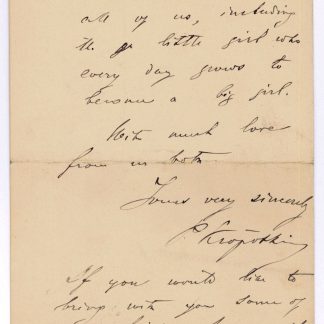
Autograph letter signed ("P. Kropotkin").Viola Cottage, Bromley, Kent, 7 Jun 1899.
€ 2,500.00 -
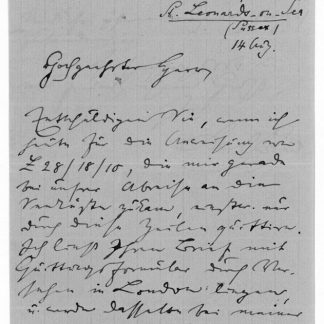
Autograph letter signed.St Leonards-on-Sea , 14 August, no year.
€ 800.00 -
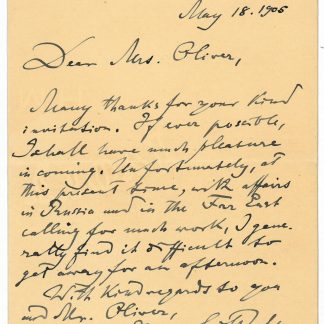
Autograph letter signed.London
€ 3,500.00